
Editorial · Rituals, art, philosophy
Editorial · Rituals, art, philosophy
Seven scenes · 1347–2025
Seven scenes · 1347–2025

Deathcar / The car opens to reveal its skeleton. This essay looks beneath the surface of how we live with death.
Die to Be Born
Die to Be Born
A short history of how we learned to live with death.

One recurring question: how do we live knowing that life ends?
The same border.
Seven ways to face it.
Every culture has had to decide what to do with death. Some turned it into a rite of passage, others into a dance, a warning, a theatre, a joke.
Every culture has had to decide what to do with death. Some turned it into a rite of passage, others into a dance, a warning, a theatre, a joke.
Seven scenes, from initiation rituals to medieval death dances, Victorian mourning, Disney’s dancing skeletons and Sartre’s locked room.
Seven scenes, from initiation rituals to medieval death dances, Victorian mourning, Disney’s dancing skeletons and Sartre’s locked room.
Chapters
Chapters
01 Rite of passage
01 Rite of passage
Die to Be Born
Die to Be Born
Why begin with initiation?
We begin not with the end of life, but with a symbolic death.
We begin not with the end of life, but with a symbolic death.
This is where our story begins: with death not only as disappearance, but as a change of state.
This is where our story begins: with death not only as disappearance, but as a change of state.
Initiation is a rite of passage: the border between child and adult. To become an adult, you first had to die as a child. Not metaphorically. Ritually.
You crossed the line between life and death and came back someone else.
You crossed the line between life and death and came back someone else.


Fig. 01 — Edward S. Curtis, Hamatsa Emerging from the Woods — Koskimo, 1914. Photograph. Library of Congress.
The three-stage pattern — separation, liminality and reincorporation — was described by anthropologist Arnold van Gennep in 1909 and later developed by Victor Turner.
Separatio
1
Limen
2
Reaggregatio
3
1. Separatio — separation
1. Separatio — separation
A rough break with the world of childhood, the world of the mother. The child is taken from home and led into the forest, the bush, a cave. Away from the mother, away from everything familiar.
A rough break with the world of childhood, the world of the mother. The child is taken from home and led into the forest, the bush, a cave. Away from the mother, away from everything familiar.

Fig. 03 — Ivan Bilibin, Vasilisa outside Baba Yaga’s Hut, illustration for Vasilisa the Beautiful, 1899–1900.
Fig. 02 — Land diving (naghol), Pentecost Island, Vanuatu: a ritual jump from a wooden tower. Photograph; photographer and date unresolved.
2. Limen — the threshold
Limen is Latin for threshold: the border between worlds. Neophytes were kept in an unseen, sacred world for months, sometimes a year. What happened there followed a similar logic in many places.
Limen is Latin for threshold: the border between worlds. Neophytes were kept in an unseen, sacred world for months, sometimes a year. What happened there followed a similar logic in many places.
Symbolic death.
Symbolic death.
They were bound, blindfolded, smeared with soot or blood. They received wounds, scars, tattoos, circumcision.
They were bound, blindfolded, smeared with soot or blood. They received wounds, scars, tattoos, circumcision.
Prohibitions.
Prohibitions.
No food, no speech, life in darkness. A renunciation of ambition and desire, a return to the state before birth.
No food, no speech, life in darkness. A renunciation of ambition and desire, a return to the state before birth.
Revelation.
Revelation.
The neophyte learned what children are not allowed to know: the tribe’s myths and the names of its gods, the meaning of death he had just symbolically survived, the laws of adult sexuality.
The neophyte learned what children are not allowed to know: the tribe’s myths and the names of its gods, the meaning of death he had just symbolically survived, the laws of adult sexuality.
Teaching.
Teaching.
Secret songs, hunting, the history of the ancestors, maps of the stars, the laws of the community.
Secret songs, hunting, the history of the ancestors, maps of the stars, the laws of the community.
Pain as a message.
Pain as a message.
Through pain the boy understood one thing: there is no way back to who you were.
3. Reaggregatio — return
The neophyte returns to the community, but as another person, with a new name, a new status and a new body, marked by scars and tattoos.
The neophyte returns to the community, but as another person, with a new name, a new status and a new body, marked by scars and tattoos.
And the most important part:
And the most important part:
she mourns the child who did not come back.
she mourns the child who did not come back.

In some traditions, the returning initiate behaves as though he no longer knows his own mother. The ritual marks the end of one identity and the beginning of another.
In some traditions, the returning initiate behaves as though he no longer knows his own mother. The ritual marks the end of one identity and the beginning of another.
1
1
Separatio
Separatio
2
2
Limen
Limen
3
3
Reaggregatio
Reaggregatio
From the symbolic death of one person to a collective confrontation with mortality.
02 Paris, 1424
02 Paris, 1424
Danse Macabre
Danse Macabre
Death Dances with Everyone
25 million
50,000.
half
Between 1347 and 1352 the plague killed around Europeans, a third of the continent.
Between 1347 and 1352 the plague killed around 25 million Europeans, a third of the continent.
Florence went from people to
Florence went from 120,000 people to 50,000.
120,000
Paris lost its population.
Paris lost half its population.
Out of this came the Danse Macabre, the Dance of Death, a motif that became a genre of its own in medieval art. Its first known image appeared in 1424 on the wall of the Cemetery of the Holy Innocents in Paris.
Out of this came the Danse Macabre, the Dance of Death, a motif that became a genre of its own in medieval art. Its first known image appeared in 1424 on the wall of the Cemetery of the Holy Innocents in Paris.
A skeleton dances with the pope, the emperor, a merchant, a peasant, a child. No exceptions.
A skeleton dances with the pope, the emperor, a merchant, a peasant, a child. No exceptions.
In 1485 the Parisian printer Guy Marchant published a printed adaptation of the mural, with woodcuts often associated with Pierre Le Rouge. It was reprinted and imitated again and again. The original Paris mural was destroyed in 1669. Its printed images survived.
In 1485 the Parisian printer Guy Marchant published a printed adaptation of the mural, with woodcuts often associated with Pierre Le Rouge. It was reprinted and imitated again and again. The original Paris mural was destroyed in 1669. Its printed images survived.

Fig. 04 — Anonymous German artist, The Dance of Death, 16th century. Pen and brown ink, watercolour, gouache and gold paint. The Metropolitan Museum of Art, New York (1996.70).
Death had become mass media.
Death had become mass media.


Figs. 05–07 — English satirical print, Dance of Death, 1790s. Hand-coloured etching (details); attribution unresolved, possibly Richard Newton.
Death leaves the public stage and enters the private interior.
03 Dutch Republic, 17th c.
03 Dutch Republic, 17th c.

Vanity of Vanities

Two centuries later, death moved from the cemetery wall to the dining table.
In the 17th century the Dutch Republic was booming: trade, money, luxury. And its painters answered with still lifes that were warnings.
In the 17th century the Dutch Republic was booming: trade, money, luxury. And its painters answered with still lifes that were warnings.
The vocabulary was precise.
The vocabulary was precise.
01
A skull.
02
An overturned glass.
03
A candle burning down to a smouldering wick.
04
A half-peeled lemon, beautiful outside and bitter within.
05
Gold coins, a clock, books with dog-eared pages.


Fig. 08 — Jacques de Gheyn II, Vanitas Still Life, 1603. Oil on wood. The Metropolitan Museum of Art, New York.
The genre took its name from Ecclesiastes 1:2: “vanity of vanities”. In 1603 Jacques de Gheyn II painted what is considered the first known vanitas: a skull beneath a huge soap bubble. Reflected in the bubble are a wheel of torture and a leper’s rattle.
The genre took its name from Ecclesiastes 1:2: “vanity of vanities”. In 1603 Jacques de Gheyn II painted what is considered the first known vanitas: a skull beneath a huge soap bubble. Reflected in the bubble are a wheel of torture and a leper’s rattle.
Vanitas vanitatum
Vanitas vanitatum
A human life, as fragile as a bubble.
Fig. 09 — Pieter van Laer, Self-Portrait with Magic Scene, c. 1635–37. Oil on canvas. The Leiden Collection, New York.
04 London, 1861–1901
04 London, 1861–1901
In 1861 Prince Albert died. Queen Victoria put on black and never took it off: for forty years, until her own death in 1901.
1861
1861
1901
1901
She turned private grief into a national aesthetic, and funerals became theatre:
I.
black horses crowned with ostrich plumes;
II.
velvet drapes on carriages, lamp posts and whole buildings;
III.
hired mourners draped in crêpe;
IV.
mourning brooches with a lock of the dead person’s hair inside;
V.
etiquette manuals dictated how long to mourn, what to wear and which fabrics were appropriate.

Fig. 11 — Mourning brooch containing the hair of a deceased relative, 19th century. Wellcome Collection, L0036419.

Fig. 12 — Women in mourning dress. 19th-century photograph; source unresolved.

Fig. 13 — Studio portrait of two women in mourning, Bowdoin studio, Washington, D.C., 19th century.

Fig. 14 — Queen Victoria’s mourning dress, 1892, being mounted by textile conservator Emily Austin. London Museum.


The Industry of Mourning
Fig. 10 — Alexander Bassano, Queen Victoria, 1882. Photograph; later colourisation.
05 Underground
05 Underground
The Victorians feared death less than being buried too early.
Even in the nineteenth century, doctors could not always distinguish death from deep unconsciousness. Fear of premature burial became a cultural obsession.
Even in the nineteenth century, doctors could not always distinguish death from deep unconsciousness. Fear of premature burial became a cultural obsession.
The answer was the safety coffin:
The answer was the safety coffin:
a bell on a cord running from inside the coffin up to the surface;
a bell on a cord running from inside the coffin up to the surface;
Bell
Bell
an air tube to breathe through underground;
an air tube to breathe through underground;
Air
Air
a flag that would rise from the grave;
a flag that would rise from the grave;
Flag
Flag
in rare designs, a ladder for climbing out on your own.
in rare designs, a ladder for climbing out on your own.
Ladder
Ladder


Fig. 15 — Franz Vester, Improved Burial-Case, US Patent No. 81,437, 1868 (drawing, Fig. 4).
Some imagined watchmen listening for bells through the night.
Some imagined watchmen listening for bells through the night.
Yet no rescue was ever reliably documented.
Yet no rescue was ever reliably documented.
By the early twentieth century, advances in medical diagnosis had helped reduce the fear of premature burial.
By the early twentieth century, advances in medical diagnosis had helped reduce the fear of premature burial.

Fig. 16 — Edwin S. Crosby and Ell Ray Henry, Apparatus for Signalling from Graves, US Patent No. 766,171, 1904. Later colourisation.
Decades later, the skeleton returns. This time, it doesn’t come to frighten us. It comes to dance.
06 Hollywood, 1929
06 Hollywood, 1929
Death Gets Funny

Fig. 17 — Walt Disney, The Skeleton Dance, 1929. Animation by Ub Iwerks. Excerpt.
In 1929 Disney did something nobody had dared to do. Four skeletons dance in a graveyard, play each other’s ribs like a xylophone and spin their own skulls. Cinema owners were shocked: “Too strange.”
In 1929 Disney did something nobody had dared to do. Four skeletons dance in a graveyard, play each other’s ribs like a xylophone and spin their own skulls. Cinema owners were shocked: “Too strange.”
Not scary. Strange.
Not scary. Strange.
Death that doesn’t frighten you but makes you laugh broke every rule.
Death that doesn’t frighten you but makes you laugh broke every rule.
i How it started
Carl Stalling, a composer Disney had known since his Kansas City days, had an idea: let the music drive the animation, not the other way round. The first subject they chose was skeletons in a cemetery. That is how Silly Symphonies began, the series that would win seven Oscars and pave the way to Snow White.
Carl Stalling, a composer Disney had known since his Kansas City days, had an idea: let the music drive the animation, not the other way round. The first subject they chose was skeletons in a cemetery. That is how Silly Symphonies began, the series that would win seven Oscars and pave the way to Snow White.
ii The animator in the library
Ub Iwerks, co-creator of Mickey Mouse, animated almost the entire film himself. Its skeletons belong to a long line of dance-of-death images, from medieval prints to the caricatures of Thomas Rowlandson. But these skeletons would not scare. They would party.
Ub Iwerks, co-creator of Mickey Mouse, animated almost the entire film himself. Its skeletons belong to a long line of dance-of-death images, from medieval prints to the caricatures of Thomas Rowlandson. But these skeletons would not scare. They would party.
iii Why it was new
In Hollywood, death meant horror, tragedy, taboo. Disney showed it to children, as comedy, and cinemas didn’t know what to do with it. Then the cartoon became a hit, and it opened the door to a whole strand of pop culture, from Tim Burton to skeleton memes.
In Hollywood, death meant horror, tragedy, taboo. Disney showed it to children, as comedy, and cinemas didn’t know what to do with it. Then the cartoon became a hit, and it opened the door to a whole strand of pop culture, from Tim Burton to skeleton memes.
Fig. 18 — Anatomy-chart skeleton, early sound cartoon. Excerpt; title and studio unresolved.
iv Today
On 1 January 2025, The Skeleton Dance entered the US public domain. Works of its era are protected there for 95 years:
On 1 January 2025, The Skeleton Dance entered the US public domain. Works of its era are protected there for 95 years:
1929 + 95 = 2024
1929 + 95 = 2024
Even a cartoon about death eventually has its own.
07 Occupied Paris, 1943
07 Occupied Paris, 1943

people.
people.

Fig. 19 — Jean-Paul Sartre, pop-art portrait. Artist and source unresolved.
For Jean-Paul Sartre there is no fate, only freedom. You create yourself with every choice you make. But there is a moment when that freedom ends.
While you are alive, you are fluid. At forty you can drop everything and go to a monastery. You can betray a friend, and then betray yourself again. After death, it’s over. The project is closed. Now other people decide who you were.
While you are alive, you are fluid. At forty you can drop everything and go to a monastery. You can betray a friend, and then betray yourself again. After death, it’s over. The project is closed. Now other people decide who you were.
A hero? A coward? A genius?
A hero? A coward? A genius?
You no longer control what you mean.
You no longer control what you mean.
Death, for Sartre, turns freedom into essence. All your life you are free to choose; death gives you a final form.
Death, for Sartre, turns freedom into essence. All your life you are free to choose; death gives you a final form.
You become an object.
You become an object.
A thing.
A thing.
An interpretation.
An interpretation.
i No Exit
Sartre turned this idea into a play, No Exit (Huis clos), written in two weeks in occupied Paris in 1943 and staged in 1944. Three people in hell. No fire, no devils. Just a room, three sofas, a bronze statuette. Forever. Together.
Sartre turned this idea into a play, No Exit (Huis clos), written in two weeks in occupied Paris in 1943 and staged in 1944. Three people in hell. No fire, no devils. Just a room, three sofas, a bronze statuette. Forever. Together.
The torture is the gaze of others. Garcin wants to be a hero, but Inès sees a coward, and it is her verdict he needs to overturn. Estelle wants Garcin. Inès wants Estelle. No one gets what they want. Even when the door opens, no one leaves.
The torture is the gaze of others. Garcin wants to be a hero, but Inès sees a coward, and it is her verdict he needs to overturn. Estelle wants Garcin. Inès wants Estelle. No one gets what they want. Even when the door opens, no one leaves.
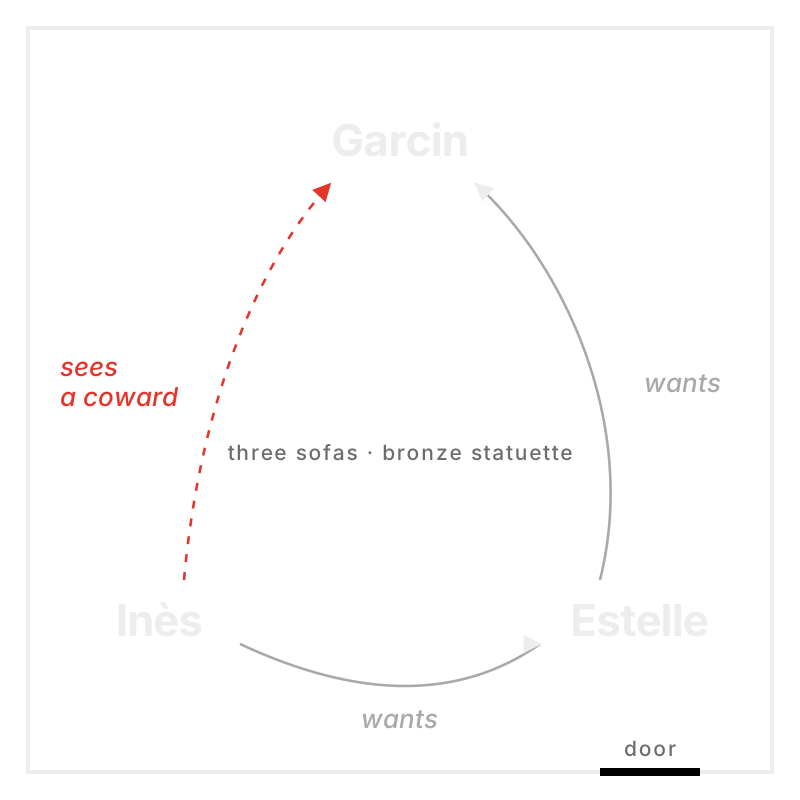
Fig. 20 — Benesh, The Room in No Exit. Diagram.
L’enfer, c’est les autres.
L’enfer, c’est les autres.

Under another’s gaze you lose control: you are what they saw in you. It is a metaphor for death. Afterwards you belong to the gaze of the living, and you can no longer say, “You’ve got me wrong, that’s not who I am.” You are how you are remembered.
Under another’s gaze you lose control: you are what they saw in you. It is a metaphor for death. Afterwards you belong to the gaze of the living, and you can no longer say, “You’ve got me wrong, that’s not who I am.” You are how you are remembered.
While you live, you are a verb.
While you live, you are a verb.
After death, a noun.
After death, a noun.
ii The Final Irony
1964
1964
In 1964 Sartre was awarded the Nobel Prize in Literature, and he turned it down. His reason: a writer must not allow himself to be turned into an institution.
In 1964 Sartre was awarded the Nobel Prize in Literature, and he turned it down. His reason: a writer must not allow himself to be turned into an institution.
To the very end, he fought against becoming a noun.
To the very end, he fought against becoming a noun.
— The thread
— The thread
And perhaps that is the thread running through all seven scenes. The tribe, the dance, the still life, the mourning dress, the bell on a cord, the grinning skeleton, the locked room: each is a way of facing the same border, and each says, in its own language, what the initiation rite said first.


You cannot come back the same.
You cannot come back the same.
Image credits
Image credits
Fig. 21 — Benesh, Deathcar, 2025. 360° render.
+ Coda
+ Coda
This essay first appeared as an Instagram editorial carousel accompanying Deathcar, the third car in the series.
This essay first appeared as an Instagram editorial carousel accompanying Deathcar, the third car in the series.
Deathcar closes the trilogy.
Fittingly, death comes last.
But art doesn’t die.

Fig. 22 — Benesh, Skin for a Car Toy, 2025. Three illustrated car skins.
Fig. 01 — Edward S. Curtis, Hamatsa Emerging from the Woods — Koskimo, 1914. Photograph. Library of Congress.
Fig. 02 — Land diving (naghol), Pentecost Island, Vanuatu: a ritual jump from a wooden tower. Photograph; photographer and date unresolved.
Fig. 03 — Ivan Bilibin, Vasilisa outside Baba Yaga’s Hut, illustration for Vasilisa the Beautiful, 1899–1900.
Fig. 04 — Anonymous German artist, The Dance of Death, 16th century. Pen and brown ink, watercolour, gouache and gold paint. The Metropolitan Museum of Art, New York (1996.70).
Figs. 05–07 — English satirical print, Dance of Death, 1790s. Hand-coloured etching (details); attribution unresolved, possibly Richard Newton.
Fig. 08 — Jacques de Gheyn II, Vanitas Still Life, 1603. Oil on wood. The Metropolitan Museum of Art, New York.
Fig. 09 — Pieter van Laer, Self-Portrait with Magic Scene, c. 1635–37. Oil on canvas. The Leiden Collection, New York.
Fig. 10 — Alexander Bassano, Queen Victoria, 1882. Photograph; later colourisation.
Fig. 11 — Mourning brooch containing the hair of a deceased relative, 19th century. Wellcome Collection, L0036419.
Fig. 12 — Women in mourning dress. 19th-century photograph; source unresolved.
Fig. 13 — Studio portrait of two women in mourning, Bowdoin studio, Washington, D.C., 19th century.
Fig. 14 — Queen Victoria’s mourning dress, 1892, being mounted by textile conservator Emily Austin. London Museum.
Fig. 15 — Franz Vester, Improved Burial-Case, US Patent No. 81,437, 1868 (drawing, Fig. 4).
Fig. 16 — Edwin S. Crosby and Ell Ray Henry, Apparatus for Signalling from Graves, US Patent No. 766,171, 1904. Later colourisation.
Fig. 17 — Walt Disney, The Skeleton Dance, 1929. Animation by Ub Iwerks. Excerpt.
Fig. 18 — Anatomy-chart skeleton, early sound cartoon. Excerpt; title and studio unresolved.
Fig. 19 — Jean-Paul Sartre, pop-art portrait. Artist and source unresolved.
Fig. 20 — Benesh, The Room in No Exit. Diagram.
Fig. 21 — Benesh, Deathcar, 2025. 360° render.
Fig. 22 — Benesh, Skin for a Car Toy, 2025. Three illustrated car skins.
Colophon
Colophon
Text, lettering, drawings and art direction: Benesh. Set in Inter and Inter Display. First made as an Instagram editorial carousel in 2025; this is the web edition.
Text, lettering, drawings and art direction: Benesh. Set in Inter and Inter Display. First made as an Instagram editorial carousel in 2025; this is the web edition.
Related project / Illustration & surface design

Skin for a Car Toy →
Skin for a Car Toy →

Editorial · Rituals, art, philosophy
EN · 8 min read
Deathcar / The car opens to reveal its skeleton. This essay looks beneath the surface of how we live with death.
Die to Be Born
A short history of how we learned to live with death.
THE SAME BORDER.
SEVEN WAYS TO FACE IT.
Every culture has had to decide what to do with death. Some turned it into a rite of passage, others into a dance, a warning, a theatre, a joke.
Seven scenes, from initiation rituals to medieval death dances, Victorian mourning, Disney’s dancing skeletons and Sartre’s locked room.
One recurring question: how do we live knowing that life ends?
Chapters
01 / 07
Rite of passage
Die to Be Born
Why begin with initiation?
We begin not with the end of life, but with a symbolic death.
This is where our story begins: with death not only as disappearance, but as a change of state.
Fig. 01 — Edward S. Curtis, Hamatsa Emerging from the Woods — Koskimo, 1914. Photograph. Library of Congress.
Initiation is a rite of passage: the border between child and adult. To become an adult, you first had to die as a child. Not metaphorically. Ritually.
You crossed the line between life and death and came back someone else.
The three-stage pattern — separation, liminality and reincorporation — was described by anthropologist Arnold van Gennep in 1909 and later developed by Victor Turner.
1
Separatio
2
Limen
3
Reaggregatio
1. Separatio — separation
A rough break with the world of childhood, the world of the mother. The child is taken from home and led into the forest, the bush, a cave. Away from the mother, away from everything familiar.
Fig. 03 — Ivan Bilibin, Vasilisa outside Baba Yaga’s Hut, 1899–1900.
Fig. 02 — Land diving (naghol), Pentecost Island, Vanuatu. Photographer and date unresolved.
2. Limen — the threshold
Limen is Latin for threshold: the border between worlds. Neophytes were kept in an unseen, sacred world for months, sometimes a year. What happened there followed a similar logic in many places.
Symbolic death.
They were bound, blindfolded, smeared with soot or blood. They received wounds, scars, tattoos, circumcision.
Prohibitions.
No food, no speech, life in darkness. A renunciation of ambition and desire, a return to the state before birth.
Revelation.
The neophyte learned what children are not allowed to know: the tribe’s myths and the names of its gods, the meaning of death he had just symbolically survived, the laws of adult sexuality.
Teaching.
Secret songs, hunting, the history of the ancestors, maps of the stars, the laws of the community.
Pain as a message.
Through pain the boy understood one thing: there is no way back to who you were.
3. Reaggregatio — return
The neophyte returns to the community, but as another person, with a new name, a new status and a new body, marked by scars and tattoos.
And the most important part:
she mourns the child who did not come back.
In some traditions, the returning initiate behaves as though he no longer knows his own mother. The ritual marks the end of one identity and the beginning of another.
From the symbolic death of one person to a collective confrontation with mortality.
02 / 07
Paris, 1424
Danse Macabre
Death dances with everyone
Between 1347 and 1352 the plague killed around
25 million
Europeans, a third of the continent.
Florence went from 120,000 people to
50,000.
Paris lost
half
its population.
Fig. 04 — Anonymous German artist, The Dance of Death, 16th century. Pen and brown ink, watercolour, gouache and gold paint. The Metropolitan Museum of Art, New York (1996.70).
Out of this came the Danse Macabre, the Dance of Death, a motif that became a genre of its own in medieval art. Its first known image appeared in 1424 on the wall of the Cemetery of the Holy Innocents in Paris.
A skeleton dances with the pope, the emperor, a merchant, a peasant, a child. No exceptions.
In 1485 the Parisian printer Guy Marchant published a printed adaptation of the mural, with woodcuts often associated with Pierre Le Rouge. It was reprinted and imitated again and again. The original Paris mural was destroyed in 1669. Its printed images survived.
Death had become mass media.
Figs. 05–07 — English satirical print, Dance of Death, 1790s. Hand-coloured etching (details); attribution unresolved, possibly Richard Newton. Swipe →
Death leaves the public stage and enters the private interior.
03 / 07
Dutch Republic, 17th c.
Vanity of vanities
Two centuries later, death moved from the cemetery wall to the dining table.
In the 17th century the Dutch Republic was booming: trade, money, luxury. And its painters answered with still lifes that were warnings.
Fig. 08 — Jacques de Gheyn II, Vanitas Still Life, 1603. Oil on wood. The Metropolitan Museum of Art, New York.
A human life, as fragile as a bubble.
The vocabulary was precise.
01
A skull.
02
An overturned glass.
03
A candle burning down to a smouldering wick.
04
A half-peeled lemon, beautiful outside and bitter within.
05
Gold coins, a clock, books with dog-eared pages.
Vanitas vanitatum
The genre took its name from Ecclesiastes 1:2: “vanity of vanities”. In 1603 Jacques de Gheyn II painted what is considered the first known vanitas: a skull beneath a huge soap bubble. Reflected in the bubble are a wheel of torture and a leper’s rattle.
Fig. 09 — Pieter van Laer, Self-Portrait with Magic Scene, c. 1635–37. Oil on canvas. The Leiden Collection, New York.
04 / 07
London, 1861–1901
The industry of mourning
Fig. 10 — Alexander Bassano, Queen Victoria, 1882. Photograph; later colourisation.
In 1861 Prince Albert died. Queen Victoria put on black and never took it off: for forty years, until her own death in 1901.
1861
1901
She turned private grief into a national aesthetic, and funerals became theatre:
I.
black horses crowned with ostrich plumes;
II.
velvet drapes on carriages, lamp posts and whole buildings;
III.
hired mourners draped in crêpe;
IV.
mourning brooches with a lock of the dead person’s hair inside;
V.
etiquette manuals dictated how long to mourn, what to wear and which fabrics were appropriate.
Fig. 11 — Mourning brooch containing the hair of a deceased relative, 19th century. Wellcome Collection, L0036419.
Fig. 12 — Women in mourning dress. 19th-century photograph; source unresolved.
Fig. 13 — Studio portrait of two women in mourning, Bowdoin studio, Washington, D.C., 19th century.
Fig. 14 — Queen Victoria’s mourning dress, 1892, being mounted by textile conservator Emily Austin. London Museum.
05 / 07
Underground
Safety Coffins
The Victorians feared death less than being buried too early.
Even in the nineteenth century, doctors could not always distinguish death from deep unconsciousness. Fear of premature burial became a cultural obsession.
Fig. 15 — Franz Vester, Improved Burial-Case, US Patent No. 81,437, 1868 (drawing, Fig. 4).
The answer was the safety coffin:
Bell
a bell on a cord running from inside the coffin up to the surface;
Air
an air tube to breathe through underground;
Flag
a flag that would rise from the grave;
Ladder
in rare designs, a ladder for climbing out on your own.
Some imagined watchmen listening for bells through the night.
Yet no rescue was ever reliably documented.
By the early twentieth century, advances in medical diagnosis had helped reduce the fear of premature burial.
Fig. 16 — Edwin S. Crosby and Ell Ray Henry, Apparatus for Signalling from Graves, US Patent No. 766,171, 1904. Later colourisation.
Decades later, the skeleton returns. This time, it doesn’t come to frighten us. It comes to dance.
06 / 07
Hollywood, 1929
Death gets funny
Fig. 17 — Walt Disney, The Skeleton Dance, 1929. Animation by Ub Iwerks. Excerpt.
In 1929 Disney did something nobody had dared to do. Four skeletons dance in a graveyard, play each other’s ribs like a xylophone and spin their own skulls. Cinema owners were shocked: “Too strange.”
Not scary. Strange.
Death that doesn’t frighten you but makes you laugh broke every rule.
i How it started
Carl Stalling, a composer Disney had known since his Kansas City days, had an idea: let the music drive the animation, not the other way round. The first subject they chose was skeletons in a cemetery. That is how Silly Symphonies began, the series that would win seven Oscars and pave the way to Snow White.
ii The animator in the library
Ub Iwerks, co-creator of Mickey Mouse, animated almost the entire film himself. Its skeletons belong to a long line of dance-of-death images, from medieval prints to the caricatures of Thomas Rowlandson. But these skeletons would not scare. They would party.
iii Why it was new
In Hollywood, death meant horror, tragedy, taboo. Disney showed it to children, as comedy, and cinemas didn’t know what to do with it. Then the cartoon became a hit, and it opened the door to a whole strand of pop culture, from Tim Burton to skeleton memes.
Fig. 18 — Anatomy-chart skeleton, early sound cartoon. Excerpt; title and studio unresolved.
iv Today
On 1 January 2025, The Skeleton Dance entered the US public domain. Works of its era are protected there for 95 years:
1929 + 95 = 2024
Even a cartoon about death eventually has its own.
07 / 07
Occupied Paris, 1943
people.
Fig. 19 — Jean-Paul Sartre, pop-art portrait. Artist and source unresolved.
For Jean-Paul Sartre there is no fate, only freedom. You create yourself with every choice you make. But there is a moment when that freedom ends.
While you are alive, you are fluid. At forty you can drop everything and go to a monastery. You can betray a friend, and then betray yourself again. After death, it’s over. The project is closed. Now other people decide who you were.
A hero? A coward? A genius?
You no longer control what you mean.
You become an object.
A thing.
An interpretation.
Death, for Sartre, turns freedom into essence. All your life you are free to choose; death gives you a final form.
i No Exit
Sartre turned this idea into a play, No Exit (Huis clos), written in two weeks in occupied Paris in 1943 and staged in 1944. Three people in hell. No fire, no devils. Just a room, three sofas, a bronze statuette. Forever. Together.
The torture is the gaze of others. Garcin wants to be a hero, but Inès sees a coward, and it is her verdict he needs to overturn. Estelle wants Garcin. Inès wants Estelle. No one gets what they want. Even when the door opens, no one leaves.
Fig. 20 — Benesh, The Room in No Exit. Diagram.
L’enfer, c’est les autres.
Under another’s gaze you lose control: you are what they saw in you. It is a metaphor for death. Afterwards you belong to the gaze of the living, and you can no longer say, “You’ve got me wrong, that’s not who I am.” You are how you are remembered.
While you live, you are a verb.
After death, a noun.
ii The final irony
1964
In 1964 Sartre was awarded the Nobel Prize in Literature, and he turned it down. His reason: a writer must not allow himself to be turned into an institution.
To the very end, he fought against becoming a noun.
— The thread
And perhaps that is the thread running through all seven scenes. The tribe, the dance, the still life, the mourning dress, the bell on a cord, the grinning skeleton, the locked room: each is a way of facing the same border, and each says, in its own language, what the initiation rite said first.
01 The tribe
02 the dance
03 the still life
04 the mourning dress
05 the bell on a cord
06 the grinning skeleton
07 the locked room
You cannot come back the same.
+ Coda
Fig. 21 — Benesh, Deathcar, 2025. 360° render.
This essay first appeared as an Instagram editorial carousel accompanying Deathcar, the third car in the series.
Deathcar closes the trilogy. Fittingly, death comes last. But art doesn’t die.
Fig. 22 — Benesh, Skin for a Car Toy, 2025. Three illustrated car skins.
Colophon
Text, lettering, drawings and art direction: Benesh. Set in Inter and Inter Display. First made as an Instagram editorial carousel in 2025; this is the web edition. Image credits are given with each figure.