Editorial · Fairy tales · Propp · 3D sculpture
By your own will,
or by need?
Baba Yaga asks every visitor the same question. A century ago, a folklorist worked out why. The Russian wonder tale, he argued, is a recipe, and the recipe is the memory of a rite in which a child had to die, symbolically, so that an adult could come back.
This editorial accompanies a series of 3D sculptures of fairy-tale characters: Baba Yaga, Vasilisa, the Grey Wolf. Each of them is a role in a very old machine. Here is how the machine works.
How to read the claims
Fact Documented history, texts and dates.
Propp Propp’s interpretation, 1928 and 1946.
Reading Later interpretations: psychological, comparative, or this essay’s own.

Fig. 01 Liza Benesh, Baba Yaga. 3D sculpture, Blender, render.
01
The mechanics
The Recipe

Change the names, the enemies and the magic helpers. What the characters do stays exactly the same.
In the 1920s Vladimir Propp (1895–1970), a young philologist who earned his living teaching German at school, was reading Alexander Afanasyev’s Russian Folk Tales, the great nineteenth-century collection of some six hundred stories. He noticed something suspicious: the tales kept repeating themselves.
The names change: Ivan, Vasilisa. The enemies change: Koschei, the Dragon. The magic helpers change: the Grey Wolf, the Pike. But the characters’ actions do not.
Propp, 1928
Propp took one hundred wonder tales from Afanasyev and sorted them not by who appears in them, but by what happens. In Morphology of the Folktale (1928) he showed that all of them are built from the same thirty-one functions — an absence, a prohibition, its violation, the villain’s blow, the hero’s departure, the test, the magical gift, the struggle, the return, the wedding. They always come in the same order, though no single tale uses them all. Around these actions move only seven characters.

Fig. 02 Vladimir Propp (1895–1970). Photograph.

Fig. 03 Narodnye russkie skazki A. N. Afanaseva, vol. 4, ed. A. E. Gruzinsky, with pictures by A. Komarov and M. Shcheglov. Title page.

Fig. 04 Vladimir Propp, Morphology of the Folktale and The Historical Roots of the Wonder Tale. KoLibri, Moscow. Cover.
Diagram A — The machine: 31 functions, 7 roles
Read left to right: the functions always come in this order, though no tale uses them all. Each role owns a “sphere of action” — the functions it can perform. Red: the donor’s test and gift, the hinge of the tale. Propp, 1928
Preparation
Complication
Donor · passage
Struggle
Return
Recognition
I
Absentation
II
Interdiction
III
Violation
IV
Reconnaissance
V
Delivery
VI
Trickery
VII
Complicity
VIII
Villainy / lack
IX
Mediation
X
Counteraction
XI
Departure
XII
Test by the donor
XIII
Hero’s reaction
XIV
Magical gift
XV
Guidance
XVI
Struggle
XVII
Branding
XVIII
Victory
XIX
Lack undone
XX
Return
XXI
Pursuit
XXII
Rescue
XXIII
Arrival unrecognised
XXIV
False claims
XXV
Difficult task
XXVI
Solution
XXVII
Recognition
XXVIII
Exposure
XXIX
Transfiguration
XXX
Punishment
XXXI
Wedding
Villain
Koschei, the Dragon
Donor
Baba Yaga
Helper
the Grey Wolf
Princess and her father
Vasilisa
Dispatcher
the one who sends
Hero
Ivan
False hero
the impostor
Diagram A — The machine: 31 functions, 7 roles
Read top to bottom: the functions always come in this order, though no tale uses them all. Red: the donor’s test and gift, the hinge of the tale. Propp, 1928
Preparation
I
Absentation
II
Interdiction
III
Violation
IV
Reconnaissance
V
Delivery
VI
Trickery
VII
Complicity
Complication
VIII
Villainy / lack
IX
Mediation
X
Counteraction
XI
Departure
Donor · passage
XII
Test by the donor
XIII
Hero’s reaction
XIV
Magical gift
XV
Guidance
Struggle
XVI
Struggle
XVII
Branding
XVIII
Victory
Return
XIX
Lack undone
XX
Return
XXI
Pursuit
XXII
Rescue
Recognition
XXIII
Arrival unrecognised
XXIV
False claims
XXV
Difficult task
XXVI
Solution
XXVII
Recognition
XXVIII
Exposure
XXIX
Transfiguration
XXX
Punishment
XXXI
Wedding
Villain
Koschei, the Dragon
Donor
Baba Yaga
Helper
the Grey Wolf
Princess and her father
Vasilisa
Dispatcher
the one who sends
Hero
Ivan
False hero
the impostor
The tale works like an algorithm. You can swap the variables. You cannot rearrange the code.
Fact
For three decades the book was barely read outside Russia. Its English translation in 1958 turned it into a founding text of structuralism — Claude Lévi-Strauss answered it in 1960 — and later into an unofficial manual for screenwriters and game designers.
Not the hero’s journey
Propp is often confused with Joseph Campbell, whose The Hero with a Thousand Faces (1949) traced one “monomyth” across the world’s religions and myths. Propp was narrower and more exact: one corpus, one genre, formal functions. The two models are often blurred together, but they are not the same thing.
02
The origins
A Rite, Frozen
The fairy tale is a frozen initiation rite.

Fig. 05 Liza Benesh, Vasilisa. 3D sculpture, Blender, render.
Propp, 1946
Morphology explained how the tale is built. It did not explain why it is built that way. That became the question of Propp’s second book, The Historical Roots of the Wonder Tale (1946).
His answer: when the rites that turned children into adults disappeared, their sequence survived as story. Much of what looks like pure invention is ritual memory: the hut in the deep forest, the frog bride, the rule that you must not eat until you are invited, the hero who is swallowed by a monster and spat out again, the forbidden room.
In the rite, an adolescent was taken from home into the forest, “died” there symbolically, was taught, marked and given a new name, and came back as an adult. In the tale, the hero is sent into the forest, crosses into the kingdom of the dead, receives a magical gift and returns to marry and to rule.
This is why the wonder tale is always about leaving home. The plot is the passage.
Diagram B — The passage: rite and tale, step by step
Arnold van Gennep’s three stages of a rite of passage (1909), laid over Propp’s reading of the tale (1946). The dashed red line is the border of the other world: the forest. Propp Van Gennep’s model

1 · SEPARATION
2 · LIMINALITY — THE THRESHOLD
3 · REINCORPORATION
BORDER OF THE OTHER WORLD · THE FOREST
HOME
HOME — AS AN ADULT
THE HUT AT THE EDGE OF THE FOREST
THE THRICE-TENTH KINGDOM: THE KINGDOM OF THE DEAD
BACK ACROSS
THE RITE
THE TALE
taken from home into the forest
“dies” symbolically · is taught,
marked, given a new name
comes back an adult
sent into the forest
crosses into the kingdom of the dead,
receives a magical gift
returns to marry and to rule
Diagram B — The passage: rite and tale, step by step
Arnold van Gennep’s three stages of a rite of passage (1909), laid over Propp’s reading of the tale (1946). The dashed red line is the border of the other world: the forest. Propp Van Gennep’s model
1 · SEPARATION
HOME
THE HUT AT THE EDGE OF THE FOREST
THE RITE
taken from home into the forest
THE TALE
sent into the forest
BORDER OF THE OTHER WORLD · THE FOREST
2 · LIMINALITY — THE THRESHOLD
THE THRICE-TENTH KINGDOM: THE KINGDOM OF THE DEAD
THE RITE
“dies” symbolically · is taught,
marked, given a new name
THE TALE
crosses into the kingdom of the dead,
receives a magical gift
3 · REINCORPORATION
BACK ACROSS
HOME — AS AN ADULT
THE RITE
comes back an adult
THE TALE
returns to marry and to rule
03
The threshold
The Gatekeeper

Propp showed that Yaga is a priestess of the dead: the keeper of the gate between worlds.
At the edge of the other world, the hero meets Baba Yaga. Propp’s reading of her is the heart of his book, and most of her strangeness turns out to be funerary.
Diagram C — The hut, read as a grave
What the tales actually say Fact , and how Propp read it Propp . The hut stands on the border: its back to the hero, its face to the forest.

THE FOREST · THE OTHER WORLD
THE HERO’S WORLD
1
2
3
4
5
6
7
1 · The hut on chicken legs
Fact Some peoples of the Russian North raised small houses of the dead on stumps above the ground. Propp The hut’s posts recall them.
2 · “Little hut, turn your back to the forest and your front to me”
Fact The formula the hero must say. Propp The house faces the other world, and he has to make it turn.
3 · The stove and the bathhouse
Fact Yaga heats the bath, feeds the hero and puts him to bed. Propp Fire is cremation and transformation; this is the food and the washing of the dead. Whoever eats with Yaga becomes, for a while, one of hers, and may pass.
4 · A nose grown into the ceiling
Fact Yaga lies stretched across a hut too small for her, from corner to corner. Propp Like a body in a coffin.
5 · A bony leg
Propp One leg is already bone: she is half in the other world.
6 · “It smells of Russian spirit”
Propp The dead can smell the living. The hero arrives from the wrong side of the border.
7 · The border
Propp Yaga is the keeper of the gate between worlds.

Fig. 06 Grave houses on posts (domovina), Russian North. Drawing.

Liza Benesh, Hand with an Apple. 3D sculpture, Blender, render.
That makes her one of the most ambiguous figures in folklore. In some tales she tests and gifts, in others she kidnaps and roasts children, in others still she rides out to war.
Reading
The folklorist Andreas Johns called her “the ambiguous mother and witch”: both are true at once, because a gatekeeper is dangerous by design.
Yaga’s question
“Are you here by your own will, or by need?”
The classic answer: “Partly by my own will, but twice as much by need.”
She is checking whether you are ready, of your own accord, to enter the world of the dead. Her job is not to destroy the hero. It is to stop anyone who is not ready.
The name Fact
Baba is simply “old woman”. Yaga is uncertain. The most common derivation goes back to a Proto-Slavic root linked with Lithuanian engti, “to oppress, to torment”; a link to words for “snake” has been proposed but is disputed.
The date Fact
The earliest clear written mention is in Mikhail Lomonosov’s Russian Grammar (1755). The English envoy Giles Fletcher, who visited Russia in 1588, is sometimes cited earlier, but that attribution is contested. The figure itself is certainly older; how much older cannot be dated.
04
The guardians
The Donor and the Helper


The guide stands on the border between worlds, tests the hero and decides whether to let him through.
Propp
In Propp’s scheme the border is guarded by two different roles. The donor tests the hero and, if he passes, hands over a magical agent. The helper then carries, guides and rescues him. Yaga is the classic donor. The Grey Wolf is the classic helper. One decides whether you may cross; the other takes you across.
Diagram D — Who decides, who carries
Functions XII–XXII. Red: the donor’s sphere (XII–XIV). White: the helper’s (from XV). Propp, 1928 — the modern heirs in the last row are this essay’s reading Reading .
XII
The test
XIII
The hero’s reaction
XIV
The magical gift
XV
Guidance to the place sought
XVI
Struggle
XVII
Branding
XVIII
Victory
XIX
The lack undone
XX
Return
XXI
Pursuit
XXII
Rescue
The donor
Baba Yaga
The helper
The Grey Wolf
Functions
XII–XIV: the test, the hero’s reaction, the gift.
XV and after: guidance, rescue, solving the task.
Where
At the border, in her hut. She does not cross.
On the road. He carries the hero all the way.
What happens
She asks, sets tasks, decides. Pass, and she gives — in Vasilisa’s tale, fire in a skull.
He serves with his own body: speed, cunning, the power to change shape.
In one line
Decides whether you may cross.
Takes you across.
Modern heirs Reading
Yubaba, who takes a name and sets labour. Morpheus, who offers the pill and waits.
Hagrid, who leads the hero in. Chewbacca, who carries him. The Disney sidekick.
Diagram D — Who decides, who carries
Functions XII–XXII. Red: the donor’s sphere (XII–XIV). White: the helper’s (from XV). Propp, 1928
XII
The test
XIII
The hero’s reaction
XIV
The magical gift
XV
Guidance to the place sought
XVI
Struggle
XVII
Branding
XVIII
Victory
XIX
The lack undone
XX
Return
XXI
Pursuit
XXII
Rescue
The donor
Baba Yaga
Functions
XII–XIV: the test, the hero’s reaction, the gift.
Where
At the border, in her hut. She does not cross.
What happens
She asks, sets tasks, decides. Pass, and she gives — in Vasilisa’s tale, fire in a skull.
In one line
Decides whether you may cross.
The helper
The Grey Wolf
Functions
XV and after: guidance, rescue, solving the task.
Where
On the road. He carries the hero all the way.
What happens
He serves with his own body: speed, cunning, the power to change shape.
In one line
Takes you across.
The roles survived the end of the folk tale almost untouched.
Yubaba (Spirited Away, Hayao Miyazaki, 2001), the witch of a bathhouse for spirits, takes the heroine’s name — a symbolic death — and tests her with labour. Tellingly, Miyazaki splits the Yaga in two: harsh Yubaba and her kind twin sister Zeniba.
Hagrid (Harry Potter, J. K. Rowling), a giant at the edge of the forest, keeper of keys, the first to lead the hero into the magic world.
Chewbacca (Star Wars), a hairy giant who speaks a non-human language and carries the hero where he could not go on foot.
Morpheus (The Matrix, 1999) offers a red pill or a blue one. The choice is consent to initiation: take the red one and you enter another world, with no way back. He does not force anyone; he tests readiness. It is Yaga’s question, asked in a black coat.

Spirited Away (Hayao Miyazaki, Studio Ghibli, 2001). Film still.

Harry Potter and the Philosopher’s Stone (Warner Bros., 2001). Film still.

The Matrix (Warner Bros., 1999). Film still.
05
The helper
The Grey Wolf


Fig. 09 Viktor Vasnetsov, Ivan Tsarevich Riding the Grey Wolf, 1889. Oil on canvas. State Tretyakov Gallery, Moscow. Detail.
The Grey Wolf is the most familiar helper of all, and first he eats Ivan’s horse.

Fig. 08 Liza Benesh, Wolf. 3D sculpture, Blender, render.
Fact
In Afanasyev’s Ivan Tsarevich, the Firebird and the Grey Wolf, the wolf tears apart the hero’s horse, then takes pity on him and offers to carry him instead. The order matters: first a loss, then service.
The horse, the hero’s ordinary way of moving through the world, is gone. In its place comes a creature that can run where “neither a rider nor a walker can go”, to the “thrice-tenth kingdom” Propp that Propp read as the other world.
Three readings Reading
The shapeshifter
The wolf becomes a horse, a princess, whatever is needed: the mediator’s power of transformation.
The guide of souls
As wolves and dogs are in many Indo-European traditions.
The debtor
Having taken something, it is bound to repay.
None of these is proven; all of them explain why the helper in the tale is never just a pet.

Viktor Vasnetsov, Ivan Tsarevich Riding the Grey Wolf, 1889. The whole canvas.
Reading
Disney’s animal sidekicks are the same role, softened: Sebastian, Pascal, Abu, Mushu, Olaf. They advise, they do what the hero cannot, they are funny but wise, half trickster and half helper.
In the archaic tale the helper is an ancestor spirit, a guide between worlds. In the studio film it becomes an inner voice, conscience or intuition. The structure is identical: the helper arrives after the test, leads the hero and saves him at the decisive moment.

The Little Mermaid (Walt Disney Pictures, 1989). Flounder. Film still.
06
The one who crosses
Vasilisa: A Function, Not a Character

Vasilisa = Marya Morevna
= Elena the Beautiful = the Tsar-Maiden.
The name changes; the role stays: a woman who tests, chooses and commands magic.
The Wise
The daughter of the Sea King, a shaman. She turns into a swan or a frog and weaves a carpet with the whole world on it in a single night.
The Beautiful
The one who goes through initiation herself — below.
The Frog Princess
The totemic bride. Her animal skin marks her as belonging to another kin, another world.
The Tsar-Maiden
The one who tests the hero: fail, and lose your head. She rules on her own, and a husband is a rival.
The girl who brought back fire
The tale
In Vasilisa the Beautiful, the girl’s mother dies when she is eight, leaving her a small doll and a blessing. A stepmother sends her into the forest to fetch fire from Baba Yaga.
On the way she meets three riders, white, red and black, who turn out to be Yaga’s servants: morning, the sun and night. Yaga gives her impossible tasks, and the doll does them.
When Yaga asks how, Vasilisa answers: “By my mother’s blessing.” Yaga wants nothing blessed in her house and sends her home with fire in a skull on a stick. At home, the skull’s eyes burn the stepmother and her daughters to ash.
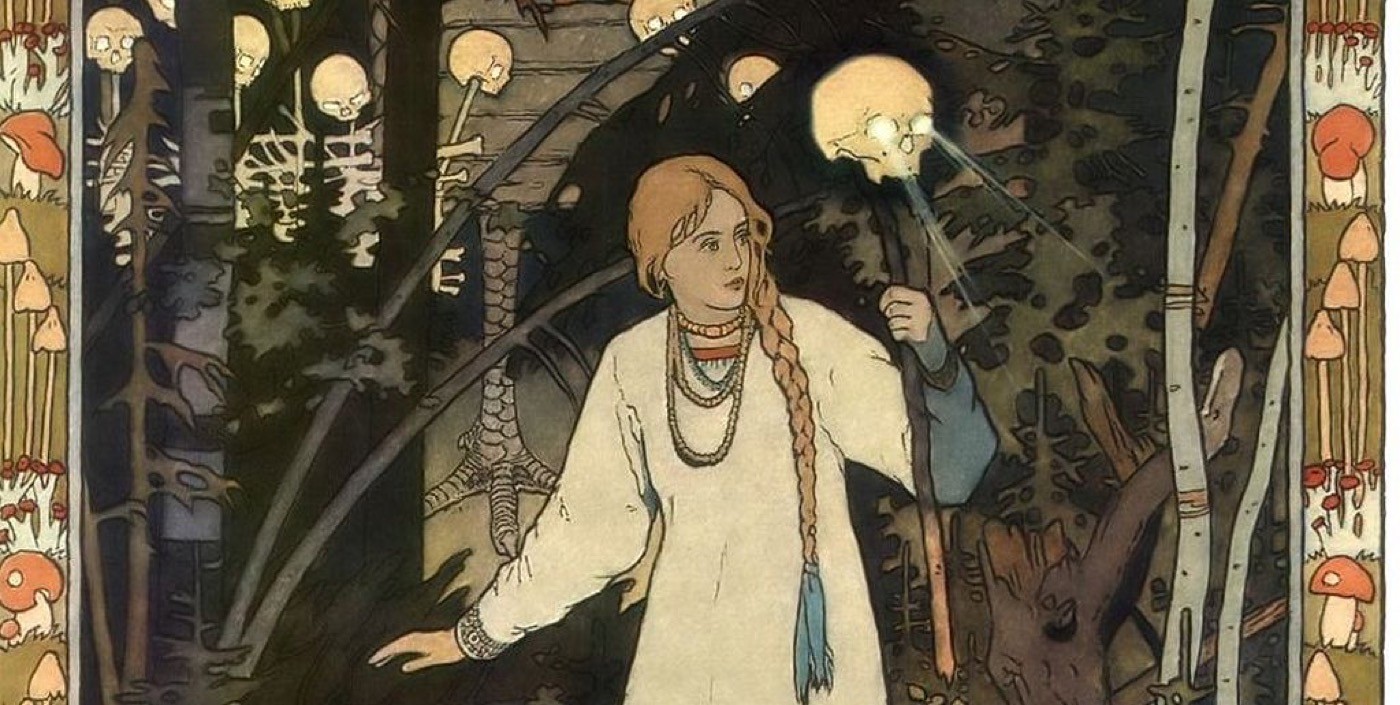
Fig. 10 Ivan Bilibin, Vasilisa outside Baba Yaga’s Hut, illustration for Vasilisa the Beautiful, 1899–1900.

Fig. 11 Liza Benesh, Vasilisa, preparatory sketch.
Propp linked initiation to coming of age.
Reading
Later readers, most famously the Jungian analyst Clarissa Pinkola Estés in Women Who Run With the Wolves (1992), read this tale as a girl’s rite of passage: separation from the home, a stay with an older woman who teaches the knowledge of the body and the household, and a return as someone else.
The doll is the mother’s presence carried into the forest. The skull’s fire is the power of the other world, and what it burns is childhood itself.
White rider
Morning
Red rider
The sun
07
Today
Initiation 2.0

Initiation hasn’t gone anywhere. We no longer send adolescents through the jaws of a monster, but the mechanism is still here.
01
A change of appearance
02
Giving up your name
03
Isolation
04
The trial
05
Coming back as someone else
Fact
In 1909 the anthropologist Arnold van Gennep described every rite of passage in three stages: separation, a threshold, and reincorporation. Victor Turner later developed the middle one into a theory of its own: the liminal phase, when you are no longer who you were and not yet who you will be.
Modern life is full of such thresholds. They differ in one thing: who chose them.

Forrest Gump (Robert Zemeckis, Paramount, 1994). Film still.
Diagram E — Who chose the threshold?
Eight modern rites of passage, placed by how freely they are entered. The placement is this essay’s judgement Reading ; the rites themselves are documented practice Fact .
← By need · imposed
Chosen · by your own will →
Cults
Giving up the old name, cutting ties with family, a new identity under a guru’s control.
Prison
The uniform, tattoos as marks of rank, a new status in a closed caste.
The army
Shaved heads, a number instead of a name, isolation, hierarchy, the breaking of the old self.
Hazing
Violence as the price of entry, from sports teams to student fraternities.
Bar and bat mitzvah
At thirteen (twelve for girls), you become responsible for your own actions. Rarely a twelve-year-old’s own idea.
Quinceañera
At fifteen, flat shoes are changed for heels and she is crowned: declared a woman.
Monastic vows
Tonsure, a new name, renunciation of worldly life — but you go of your own will.
A first tattoo
You choose the pain that changes your body forever: the sign of a passage.
The sign of the imposed
You cannot leave. You did not choose. The system breaks you to make you its own.
The sign of the chosen
You decided. You went through the trial knowingly. You control the process.
Diagram E — Who chose the threshold?
Eight modern rites of passage, placed by how freely they are entered. The placement is this essay’s judgement Reading
↑ By need · imposed
Cults
Giving up the old name, cutting ties with family, a new identity under a guru’s control.
Prison
The uniform, tattoos as marks of rank, a new status in a closed caste.
The army
Shaved heads, a number instead of a name, isolation, hierarchy, the breaking of the old self.
Hazing
Violence as the price of entry, from sports teams to student fraternities.
Bar and bat mitzvah
At thirteen (twelve for girls), you become responsible for your own actions. Rarely a twelve-year-old’s own idea.
Quinceañera
At fifteen, flat shoes are changed for heels and she is crowned: declared a woman.
Monastic vows
Tonsure, a new name, renunciation of worldly life — but you go of your own will.
A first tattoo
You choose the pain that changes your body forever: the sign of a passage.
Chosen · by your own will ↓
The sign of the imposed
You cannot leave. You did not choose. The system breaks you to make you its own.
The sign of the chosen
You decided. You went through the trial knowingly. You control the process.
The line is not always clean. But the test is the one Yaga uses at her door: did you come by your own will?
08
The afterlife
Final Boss

Yaga never left. She moved into comics, films and games: sometimes as a guide, sometimes as just another villain.
1976
–1995
Dungeons & Dragons
Her hut appears as an artifact in Eldritch Wizardry (1976) and the Dungeon Master’s Guide (1979). In “The Dancing Hut” (Dragon #83, 1984) and the adventure The Dancing Hut of Baba Yaga (1995) the hut becomes a labyrinth between planes: a portal that tests whoever enters.
The threshold, kept
Uncanny X-Men #231 (Marvel, 1988), art by Rick Leonardi.
1980s
Marvel
Baba Yaga appears in Captain Britain and, in Uncanny X-Men #231 (1988), as a demon who kidnaps the New Mutants and is defeated by Colossus, because sorcery is weak against iron. The archetype breaks: she no longer tests, she no longer gives. She is a one-issue villain.
The archetype, broken

1989
Quest for Glory
In Sierra’s Quest for Glory: So You Want to Be a Hero, her hut on chicken legs is a place the player must enter, and survive.
The test, playable


1996
Hellboy
In Wake the Devil, Mike Mignola brings back the folklore: the hut, Koschei, the thrice-tenth kingdom. In “The Baba Yaga” (1998) Hellboy shoots out her eye, and she becomes his lifelong enemy and, ambiguously, his tester.
The ambiguity, restored
2014
John Wick
Keanu Reeves’s character is nicknamed “Baba Yaga”, glossed in the film as “the Boogeyman”, or rather the one you send to kill him. The fit is better than it looks: a figure who walks with Death.
The name, borrowed
2015
The Witcher 3
The Crones of Crookback Bog: three sisters drawn from Slavic folklore who rule a swamp, eat children and test the heroine.
The tester, tripled
Coda
By your own will,
or by need?
It is the question Yaga asks at the door, and it is still the one that separates the initiation you choose from the one that is done to you.
The 3D characters were made with the English translations of their names, so that each one could leave its tale and travel. Like the wolf, they carry something across a border.
Baba Yaga
Vasilisa
Wolf
Sources
Propp, Vladimir. Morphology of the Folktale [1928]. Trans. Laurence Scott. Bloomington, 1958; 2nd ed., University of Texas Press, 1968.
Propp, Vladimir. The Historical Roots of the Wonder Tale [Istoricheskie korni volshebnoi skazki]. Leningrad, 1946.
Afanasyev, Alexander. Russian Folk Tales [Narodnye russkie skazki], 8 vols. Moscow, 1855–1863.
Van Gennep, Arnold. The Rites of Passage [1909]. University of Chicago Press, 1960.
Turner, Victor. “Betwixt and Between: The Liminal Period in Rites de Passage” (1964); The Ritual Process (1969).
Johns, Andreas. Baba Yaga: The Ambiguous Mother and Witch of the Russian Folktale. Peter Lang, 2004.
Estés, Clarissa Pinkola. Women Who Run With the Wolves. Ballantine, 1992.
Campbell, Joseph. The Hero with a Thousand Faces. Pantheon, 1949.
Lévi-Strauss, Claude. “La structure et la forme: réflexions sur un ouvrage de Vladimir Propp” (1960).
Vasmer, Max. Etymological Dictionary of the Russian Language, entry “yaga”.
Lomonosov, Mikhail. Russian Grammar [Rossiiskaia grammatika], 1755.
Gygax, Gary. Dungeon Master’s Guide, TSR, 1979; Moore, Roger E. “The Dancing Hut”, Dragon #83, 1984; Smedman, Lisa. The Dancing Hut of Baba Yaga, TSR, 1995.
Claremont, Chris, and Rick Leonardi. Uncanny X-Men #231, Marvel, 1988.
Mignola, Mike. Hellboy: Wake the Devil, Dark Horse, 1996; “The Baba Yaga”, in Hellboy: The Chained Coffin and Others, 1998.
Fairy tales · Propp · Baba Yaga
Text and 3D sculpture: Liza Benesh
Related project / 3D & character design
Fairytale Characters →
Editorial · Fairy tales · Propp · 3D sculpture
By your own will,
or by need?
Baba Yaga asks every visitor the same question. A century ago, a folklorist worked out why. The Russian wonder tale, he argued, is a recipe, and the recipe is the memory of a rite in which a child had to die, symbolically, so that an adult could come back.
This editorial accompanies a series of 3D sculptures of fairy-tale characters: Baba Yaga, Vasilisa, the Grey Wolf. Each of them is a role in a very old machine. Here is how the machine works.
How to read the claims
Fact Documented history, texts and dates.
Propp Propp’s interpretation, 1928 and 1946.
Reading Later interpretations: psychological, comparative, or this essay’s own.
Fig. 01 Liza Benesh, Baba Yaga. 3D sculpture, Blender, render.
01
The mechanics
The Recipe
Change the names, the enemies and the magic helpers. What the characters do stays exactly the same.
In the 1920s Vladimir Propp (1895–1970), a young philologist who earned his living teaching German at school, was reading Alexander Afanasyev’s Russian Folk Tales, the great nineteenth-century collection of some six hundred stories. He noticed something suspicious: the tales kept repeating themselves.
The names change: Ivan, Vasilisa. The enemies change: Koschei, the Dragon. The magic helpers change: the Grey Wolf, the Pike. But the characters’ actions do not.
Propp, 1928
Propp took one hundred wonder tales from Afanasyev and sorted them not by who appears in them, but by what happens. In Morphology of the Folktale (1928) he showed that all of them are built from the same thirty-one functions — an absence, a prohibition, its violation, the villain’s blow, the hero’s departure, the test, the magical gift, the struggle, the return, the wedding. They always come in the same order, though no single tale uses them all. Around these actions move only seven characters.
Fig. 02 Vladimir Propp (1895–1970). Photograph.
Fig. 03 Narodnye russkie skazki A. N. Afanaseva, vol. 4, ed. A. E. Gruzinsky, with pictures by A. Komarov and M. Shcheglov. Title page.
Fig. 04 Vladimir Propp, Morphology of the Folktale and The Historical Roots of the Wonder Tale. KoLibri, Moscow. Cover.
Diagram A — The machine: 31 functions, 7 roles
Read left to right: the functions always come in this order, though no tale uses them all. Each role owns a “sphere of action” — the functions it can perform. Red: the donor’s test and gift, the hinge of the tale. Propp, 1928
Preparation
Complication
Donor · passage
Struggle
Return
Recognition
I
Absentation
II
Interdiction
III
Violation
IV
Reconnaissance
V
Delivery
VI
Trickery
VII
Complicity
VIII
Villainy / lack
IX
Mediation
X
Counteraction
XI
Departure
XII
Test by the donor
XIII
Hero’s reaction
XIV
Magical gift
XV
Guidance
XVI
Struggle
XVII
Branding
XVIII
Victory
XIX
Lack undone
XX
Return
XXI
Pursuit
XXII
Rescue
XXIII
Arrival unrecognised
XXIV
False claims
XXV
Difficult task
XXVI
Solution
XXVII
Recognition
XXVIII
Exposure
XXIX
Transfiguration
XXX
Punishment
XXXI
Wedding
Villain
Koschei, the Dragon
Donor
Baba Yaga
Helper
the Grey Wolf
Princess and her father
Vasilisa
Dispatcher
the one who sends
Hero
Ivan
False hero
the impostor
Diagram A — The machine: 31 functions, 7 roles
Read top to bottom: the functions always come in this order, though no tale uses them all. Red: the donor’s test and gift, the hinge of the tale. Propp, 1928
Preparation
I
Absentation
II
Interdiction
III
Violation
IV
Reconnaissance
V
Delivery
VI
Trickery
VII
Complicity
Complication
VIII
Villainy / lack
IX
Mediation
X
Counteraction
XI
Departure
Donor · passage
XII
Test by the donor
XIII
Hero’s reaction
XIV
Magical gift
XV
Guidance
Struggle
XVI
Struggle
XVII
Branding
XVIII
Victory
Return
XIX
Lack undone
XX
Return
XXI
Pursuit
XXII
Rescue
Recognition
XXIII
Arrival unrecognised
XXIV
False claims
XXV
Difficult task
XXVI
Solution
XXVII
Recognition
XXVIII
Exposure
XXIX
Transfiguration
XXX
Punishment
XXXI
Wedding
Villain
Koschei, the Dragon
Donor
Baba Yaga
Helper
the Grey Wolf
Princess and her father
Vasilisa
Dispatcher
the one who sends
Hero
Ivan
False hero
the impostor
The tale works like an algorithm. You can swap the variables. You cannot rearrange the code.
Fact
For three decades the book was barely read outside Russia. Its English translation in 1958 turned it into a founding text of structuralism — Claude Lévi-Strauss answered it in 1960 — and later into an unofficial manual for screenwriters and game designers.
Not the hero’s journey
Propp is often confused with Joseph Campbell, whose The Hero with a Thousand Faces (1949) traced one “monomyth” across the world’s religions and myths. Propp was narrower and more exact: one corpus, one genre, formal functions. The two models are often blurred together, but they are not the same thing.
02
The origins
A Rite, Frozen
The fairy tale is a frozen initiation rite.
Fig. 05 Liza Benesh, Vasilisa. 3D sculpture, Blender, render.
Propp, 1946
Morphology explained how the tale is built. It did not explain why it is built that way. That became the question of Propp’s second book, The Historical Roots of the Wonder Tale (1946).
His answer: when the rites that turned children into adults disappeared, their sequence survived as story. Much of what looks like pure invention is ritual memory: the hut in the deep forest, the frog bride, the rule that you must not eat until you are invited, the hero who is swallowed by a monster and spat out again, the forbidden room.
In the rite, an adolescent was taken from home into the forest, “died” there symbolically, was taught, marked and given a new name, and came back as an adult. In the tale, the hero is sent into the forest, crosses into the kingdom of the dead, receives a magical gift and returns to marry and to rule.
This is why the wonder tale is always about leaving home. The plot is the passage.
Diagram B — The passage: rite and tale, step by step
Arnold van Gennep’s three stages of a rite of passage (1909), laid over Propp’s reading of the tale (1946). The dashed red line is the border of the other world: the forest. Propp Van Gennep’s model
1 · SEPARATION
2 · LIMINALITY — THE THRESHOLD
3 · REINCORPORATION
BORDER OF THE OTHER WORLD · THE FOREST
HOME
HOME — AS AN ADULT
THE HUT AT THE EDGE OF THE FOREST
THE THRICE-TENTH KINGDOM: THE KINGDOM OF THE DEAD
BACK ACROSS
THE RITE
THE TALE
taken from home into the forest
“dies” symbolically · is taught,
marked, given a new name
comes back an adult
sent into the forest
crosses into the kingdom of the dead,
receives a magical gift
returns to marry and to rule
Diagram B — The passage: rite and tale, step by step
Arnold van Gennep’s three stages of a rite of passage (1909), laid over Propp’s reading of the tale (1946). The dashed red line is the border of the other world: the forest. Propp Van Gennep’s model
1 · SEPARATION
HOME
THE HUT AT THE EDGE OF THE FOREST
THE RITE
taken from home into the forest
THE TALE
sent into the forest
BORDER OF THE OTHER WORLD · THE FOREST
2 · LIMINALITY — THE THRESHOLD
THE THRICE-TENTH KINGDOM: THE KINGDOM OF THE DEAD
THE RITE
“dies” symbolically · is taught,
marked, given a new name
THE TALE
crosses into the kingdom of the dead,
receives a magical gift
3 · REINCORPORATION
BACK ACROSS
HOME — AS AN ADULT
THE RITE
comes back an adult
THE TALE
returns to marry and to rule
03
The threshold
The Gatekeeper
Propp showed that Yaga is a priestess of the dead: the keeper of the gate between worlds.
At the edge of the other world, the hero meets Baba Yaga. Propp’s reading of her is the heart of his book, and most of her strangeness turns out to be funerary.
Diagram C — The hut, read as a grave
What the tales actually say Fact , and how Propp read it Propp . The hut stands on the border: its back to the hero, its face to the forest.
THE FOREST · THE OTHER WORLD
THE HERO’S WORLD
1
2
3
4
5
6
7
1 · The hut on chicken legs
Fact Some peoples of the Russian North raised small houses of the dead on stumps above the ground. Propp The hut’s posts recall them.
2 · “Little hut, turn your back to the forest and your front to me”
Fact The formula the hero must say. Propp The house faces the other world, and he has to make it turn.
3 · The stove and the bathhouse
Fact Yaga heats the bath, feeds the hero and puts him to bed. Propp Fire is cremation and transformation; this is the food and the washing of the dead. Whoever eats with Yaga becomes, for a while, one of hers, and may pass.
4 · A nose grown into the ceiling
Fact Yaga lies stretched across a hut too small for her, from corner to corner. Propp Like a body in a coffin.
5 · A bony leg
Propp One leg is already bone: she is half in the other world.
6 · “It smells of Russian spirit”
Propp The dead can smell the living. The hero arrives from the wrong side of the border.
7 · The border
Propp Yaga is the keeper of the gate between worlds.
Fig. 06 Grave houses on posts (domovina), Russian North. Drawing.
Liza Benesh, Hand with an Apple. 3D sculpture, Blender, render.
That makes her one of the most ambiguous figures in folklore. In some tales she tests and gifts, in others she kidnaps and roasts children, in others still she rides out to war.
Reading
The folklorist Andreas Johns called her “the ambiguous mother and witch”: both are true at once, because a gatekeeper is dangerous by design.
Yaga’s question
“Are you here by your own will, or by need?”
The classic answer: “Partly by my own will, but twice as much by need.”
She is checking whether you are ready, of your own accord, to enter the world of the dead. Her job is not to destroy the hero. It is to stop anyone who is not ready.
The name Fact
Baba is simply “old woman”. Yaga is uncertain. The most common derivation goes back to a Proto-Slavic root linked with Lithuanian engti, “to oppress, to torment”; a link to words for “snake” has been proposed but is disputed.
The date Fact
The earliest clear written mention is in Mikhail Lomonosov’s Russian Grammar (1755). The English envoy Giles Fletcher, who visited Russia in 1588, is sometimes cited earlier, but that attribution is contested. The figure itself is certainly older; how much older cannot be dated.
04
The guardians
The Donor and the Helper
The guide stands on the border between worlds, tests the hero and decides whether to let him through.
Propp
In Propp’s scheme the border is guarded by two different roles. The donor tests the hero and, if he passes, hands over a magical agent. The helper then carries, guides and rescues him. Yaga is the classic donor. The Grey Wolf is the classic helper. One decides whether you may cross; the other takes you across.
Diagram D — Who decides, who carries
Functions XII–XXII. Red: the donor’s sphere (XII–XIV). White: the helper’s (from XV). Propp, 1928 — the modern heirs in the last row are this essay’s reading Reading .
XII
The test
XIII
The hero’s reaction
XIV
The magical gift
XV
Guidance to the place sought
XVI
Struggle
XVII
Branding
XVIII
Victory
XIX
The lack undone
XX
Return
XXI
Pursuit
XXII
Rescue
The donor
Baba Yaga
The helper
The Grey Wolf
Functions
XII–XIV: the test, the hero’s reaction, the gift.
XV and after: guidance, rescue, solving the task.
Where
At the border, in her hut. She does not cross.
On the road. He carries the hero all the way.
What happens
She asks, sets tasks, decides. Pass, and she gives — in Vasilisa’s tale, fire in a skull.
He serves with his own body: speed, cunning, the power to change shape.
In one line
Decides whether you may cross.
Takes you across.
Modern heirs Reading
Yubaba, who takes a name and sets labour. Morpheus, who offers the pill and waits.
Hagrid, who leads the hero in. Chewbacca, who carries him. The Disney sidekick.
Diagram D — Who decides, who carries
Functions XII–XXII. Red: the donor’s sphere (XII–XIV). White: the helper’s (from XV). Propp, 1928
XII
The test
XIII
The hero’s reaction
XIV
The magical gift
XV
Guidance to the place sought
XVI
Struggle
XVII
Branding
XVIII
Victory
XIX
The lack undone
XX
Return
XXI
Pursuit
XXII
Rescue
The donor
Baba Yaga
Functions
XII–XIV: the test, the hero’s reaction, the gift.
Where
At the border, in her hut. She does not cross.
What happens
She asks, sets tasks, decides. Pass, and she gives — in Vasilisa’s tale, fire in a skull.
In one line
Decides whether you may cross.
The helper
The Grey Wolf
Functions
XV and after: guidance, rescue, solving the task.
Where
On the road. He carries the hero all the way.
What happens
He serves with his own body: speed, cunning, the power to change shape.
In one line
Takes you across.
The roles survived the end of the folk tale almost untouched.
Yubaba (Spirited Away, Hayao Miyazaki, 2001), the witch of a bathhouse for spirits, takes the heroine’s name — a symbolic death — and tests her with labour. Tellingly, Miyazaki splits the Yaga in two: harsh Yubaba and her kind twin sister Zeniba.
Hagrid (Harry Potter, J. K. Rowling), a giant at the edge of the forest, keeper of keys, the first to lead the hero into the magic world.
Chewbacca (Star Wars), a hairy giant who speaks a non-human language and carries the hero where he could not go on foot.
Morpheus (The Matrix, 1999) offers a red pill or a blue one. The choice is consent to initiation: take the red one and you enter another world, with no way back. He does not force anyone; he tests readiness. It is Yaga’s question, asked in a black coat.
Spirited Away (Hayao Miyazaki, Studio Ghibli, 2001). Film still.
Harry Potter and the Philosopher’s Stone (Warner Bros., 2001). Film still.
The Matrix (Warner Bros., 1999). Film still.
05
The helper
The Grey Wolf
Fig. 09 Viktor Vasnetsov, Ivan Tsarevich Riding the Grey Wolf, 1889. Oil on canvas. State Tretyakov Gallery, Moscow. Detail.
The Grey Wolf is the most familiar helper of all, and first he eats Ivan’s horse.
Fig. 08 Liza Benesh, Wolf. 3D sculpture, Blender, render.
Fact
In Afanasyev’s Ivan Tsarevich, the Firebird and the Grey Wolf, the wolf tears apart the hero’s horse, then takes pity on him and offers to carry him instead. The order matters: first a loss, then service.
The horse, the hero’s ordinary way of moving through the world, is gone. In its place comes a creature that can run where “neither a rider nor a walker can go”, to the “thrice-tenth kingdom” Propp that Propp read as the other world.
Three readings Reading
The shapeshifter
The wolf becomes a horse, a princess, whatever is needed: the mediator’s power of transformation.
The guide of souls
As wolves and dogs are in many Indo-European traditions.
The debtor
Having taken something, it is bound to repay.
None of these is proven; all of them explain why the helper in the tale is never just a pet.
Viktor Vasnetsov, Ivan Tsarevich Riding the Grey Wolf, 1889. The whole canvas.
Reading
Disney’s animal sidekicks are the same role, softened: Sebastian, Pascal, Abu, Mushu, Olaf. They advise, they do what the hero cannot, they are funny but wise, half trickster and half helper.
In the archaic tale the helper is an ancestor spirit, a guide between worlds. In the studio film it becomes an inner voice, conscience or intuition. The structure is identical: the helper arrives after the test, leads the hero and saves him at the decisive moment.
The Little Mermaid (Walt Disney Pictures, 1989). Flounder. Film still.
06
The one who crosses
Vasilisa: A Function, Not a Character
Vasilisa = Marya Morevna
= Elena the Beautiful = the Tsar-Maiden.
The name changes; the role stays: a woman who tests, chooses and commands magic.
The Wise
The daughter of the Sea King, a shaman. She turns into a swan or a frog and weaves a carpet with the whole world on it in a single night.
The Beautiful
The one who goes through initiation herself — below.
The Frog Princess
The totemic bride. Her animal skin marks her as belonging to another kin, another world.
The Tsar-Maiden
The one who tests the hero: fail, and lose your head. She rules on her own, and a husband is a rival.
The girl who brought back fire
The tale
In Vasilisa the Beautiful, the girl’s mother dies when she is eight, leaving her a small doll and a blessing. A stepmother sends her into the forest to fetch fire from Baba Yaga.
On the way she meets three riders, white, red and black, who turn out to be Yaga’s servants: morning, the sun and night. Yaga gives her impossible tasks, and the doll does them.
When Yaga asks how, Vasilisa answers: “By my mother’s blessing.” Yaga wants nothing blessed in her house and sends her home with fire in a skull on a stick. At home, the skull’s eyes burn the stepmother and her daughters to ash.
Fig. 10 Ivan Bilibin, Vasilisa outside Baba Yaga’s Hut, illustration for Vasilisa the Beautiful, 1899–1900.
Fig. 11 Liza Benesh, Vasilisa, preparatory sketch.
Propp linked initiation to coming of age.
Reading
Later readers, most famously the Jungian analyst Clarissa Pinkola Estés in Women Who Run With the Wolves (1992), read this tale as a girl’s rite of passage: separation from the home, a stay with an older woman who teaches the knowledge of the body and the household, and a return as someone else.
The doll is the mother’s presence carried into the forest. The skull’s fire is the power of the other world, and what it burns is childhood itself.
White rider
Morning
Red rider
The sun
07
Today
Initiation 2.0
Initiation hasn’t gone anywhere. We no longer send adolescents through the jaws of a monster, but the mechanism is still here.
01
A change of appearance
02
Giving up your name
03
Isolation
04
The trial
05
Coming back as someone else
Fact
In 1909 the anthropologist Arnold van Gennep described every rite of passage in three stages: separation, a threshold, and reincorporation. Victor Turner later developed the middle one into a theory of its own: the liminal phase, when you are no longer who you were and not yet who you will be.
Modern life is full of such thresholds. They differ in one thing: who chose them.
Forrest Gump (Robert Zemeckis, Paramount, 1994). Film still.
Diagram E — Who chose the threshold?
Eight modern rites of passage, placed by how freely they are entered. The placement is this essay’s judgement Reading ; the rites themselves are documented practice Fact .
← By need · imposed
Chosen · by your own will →
Cults
Giving up the old name, cutting ties with family, a new identity under a guru’s control.
Prison
The uniform, tattoos as marks of rank, a new status in a closed caste.
The army
Shaved heads, a number instead of a name, isolation, hierarchy, the breaking of the old self.
Hazing
Violence as the price of entry, from sports teams to student fraternities.
Bar and bat mitzvah
At thirteen (twelve for girls), you become responsible for your own actions. Rarely a twelve-year-old’s own idea.
Quinceañera
At fifteen, flat shoes are changed for heels and she is crowned: declared a woman.
Monastic vows
Tonsure, a new name, renunciation of worldly life — but you go of your own will.
A first tattoo
You choose the pain that changes your body forever: the sign of a passage.
The sign of the imposed
You cannot leave. You did not choose. The system breaks you to make you its own.
The sign of the chosen
You decided. You went through the trial knowingly. You control the process.
Diagram E — Who chose the threshold?
Eight modern rites of passage, placed by how freely they are entered. The placement is this essay’s judgement Reading
↑ By need · imposed
Cults
Giving up the old name, cutting ties with family, a new identity under a guru’s control.
Prison
The uniform, tattoos as marks of rank, a new status in a closed caste.
The army
Shaved heads, a number instead of a name, isolation, hierarchy, the breaking of the old self.
Hazing
Violence as the price of entry, from sports teams to student fraternities.
Bar and bat mitzvah
At thirteen (twelve for girls), you become responsible for your own actions. Rarely a twelve-year-old’s own idea.
Quinceañera
At fifteen, flat shoes are changed for heels and she is crowned: declared a woman.
Monastic vows
Tonsure, a new name, renunciation of worldly life — but you go of your own will.
A first tattoo
You choose the pain that changes your body forever: the sign of a passage.
Chosen · by your own will ↓
The sign of the imposed
You cannot leave. You did not choose. The system breaks you to make you its own.
The sign of the chosen
You decided. You went through the trial knowingly. You control the process.
The line is not always clean. But the test is the one Yaga uses at her door: did you come by your own will?
08
The afterlife
Final Boss
Yaga never left. She moved into comics, films and games: sometimes as a guide, sometimes as just another villain.
1976
–1995
Dungeons & Dragons
Her hut appears as an artifact in Eldritch Wizardry (1976) and the Dungeon Master’s Guide (1979). In “The Dancing Hut” (Dragon #83, 1984) and the adventure The Dancing Hut of Baba Yaga (1995) the hut becomes a labyrinth between planes: a portal that tests whoever enters.
The threshold, kept
Uncanny X-Men #231 (Marvel, 1988), art by Rick Leonardi.
1980s
Marvel
Baba Yaga appears in Captain Britain and, in Uncanny X-Men #231 (1988), as a demon who kidnaps the New Mutants and is defeated by Colossus, because sorcery is weak against iron. The archetype breaks: she no longer tests, she no longer gives. She is a one-issue villain.
The archetype, broken
1989
Quest for Glory
In Sierra’s Quest for Glory: So You Want to Be a Hero, her hut on chicken legs is a place the player must enter, and survive.
The test, playable
1996
Hellboy
In Wake the Devil, Mike Mignola brings back the folklore: the hut, Koschei, the thrice-tenth kingdom. In “The Baba Yaga” (1998) Hellboy shoots out her eye, and she becomes his lifelong enemy and, ambiguously, his tester.
The ambiguity, restored
2014
John Wick
Keanu Reeves’s character is nicknamed “Baba Yaga”, glossed in the film as “the Boogeyman”, or rather the one you send to kill him. The fit is better than it looks: a figure who walks with Death.
The name, borrowed
2015
The Witcher 3
The Crones of Crookback Bog: three sisters drawn from Slavic folklore who rule a swamp, eat children and test the heroine.
The tester, tripled
Coda
By your own will,
or by need?
It is the question Yaga asks at the door, and it is still the one that separates the initiation you choose from the one that is done to you.
The 3D characters were made with the English translations of their names, so that each one could leave its tale and travel. Like the wolf, they carry something across a border.
Baba Yaga
Vasilisa
Wolf
Sources
Propp, Vladimir. Morphology of the Folktale [1928]. Trans. Laurence Scott. Bloomington, 1958; 2nd ed., University of Texas Press, 1968.
Propp, Vladimir. The Historical Roots of the Wonder Tale [Istoricheskie korni volshebnoi skazki]. Leningrad, 1946.
Afanasyev, Alexander. Russian Folk Tales [Narodnye russkie skazki], 8 vols. Moscow, 1855–1863.
Van Gennep, Arnold. The Rites of Passage [1909]. University of Chicago Press, 1960.
Turner, Victor. “Betwixt and Between: The Liminal Period in Rites de Passage” (1964); The Ritual Process (1969).
Johns, Andreas. Baba Yaga: The Ambiguous Mother and Witch of the Russian Folktale. Peter Lang, 2004.
Estés, Clarissa Pinkola. Women Who Run With the Wolves. Ballantine, 1992.
Campbell, Joseph. The Hero with a Thousand Faces. Pantheon, 1949.
Lévi-Strauss, Claude. “La structure et la forme: réflexions sur un ouvrage de Vladimir Propp” (1960).
Vasmer, Max. Etymological Dictionary of the Russian Language, entry “yaga”.
Lomonosov, Mikhail. Russian Grammar [Rossiiskaia grammatika], 1755.
Gygax, Gary. Dungeon Master’s Guide, TSR, 1979; Moore, Roger E. “The Dancing Hut”, Dragon #83, 1984; Smedman, Lisa. The Dancing Hut of Baba Yaga, TSR, 1995.
Claremont, Chris, and Rick Leonardi. Uncanny X-Men #231, Marvel, 1988.
Mignola, Mike. Hellboy: Wake the Devil, Dark Horse, 1996; “The Baba Yaga”, in Hellboy: The Chained Coffin and Others, 1998.
Fairy tales · Propp · Baba Yaga
Text and 3D sculpture: Liza Benesh
Related project / 3D & character design
Fairytale Characters →
© Liza Benesh
Editorial · Fairy tales · Propp · 3D sculpture
By your own will, or by need?
Fig. 01 Liza Benesh, Baba Yaga. 3D sculpture, Blender, render.
Baba Yaga asks every visitor the same question. A century ago, a folklorist worked out why. The Russian wonder tale, he argued, is a recipe, and the recipe is the memory of a rite in which a child had to die, symbolically, so that an adult could come back.
This editorial accompanies a series of 3D sculptures of fairy-tale characters: Baba Yaga, Vasilisa, the Grey Wolf. Each of them is a role in a very old machine. Here is how the machine works.
How to read the claims
FACT Documented history, texts and dates.
PROPP Propp’s interpretation, 1928 and 1946.
READING Later interpretations: psychological, comparative, or this essay’s own.
The mechanics
Chapter 01 / 08
01
The Recipe
Change the names, the enemies and the magic helpers. What the characters do stays exactly the same.
In the 1920s Vladimir Propp (1895–1970), a young philologist who earned his living teaching German at school, was reading Alexander Afanasyev’s Russian Folk Tales, the great nineteenth-century collection of some six hundred stories. He noticed something suspicious: the tales kept repeating themselves.
The names change: Ivan, Vasilisa. The enemies change: Koschei, the Dragon. The magic helpers change: the Grey Wolf, the Pike. But the characters’ actions do not.
Fig. 02 Vladimir Propp (1895–1970). Photograph.
Fig. 03 Afanasyev, Narodnye russkie skazki, vol. 4. Title page.
Fig. 04 Propp, KoLibri edition. Cover.
Propp, 1928
Propp took one hundred wonder tales from Afanasyev and sorted them not by who appears in them, but by what happens. In Morphology of the Folktale (1928) he showed that all of them are built from the same thirty-one functions. They always come in the same order, though no single tale uses them all. Around these actions move only seven characters.
Diagram A — The machine: 31 functions, 7 roles
Read top to bottom: the functions always come in this order, though no tale uses them all. Red: the donor’s test and gift, the hinge of the tale. PROPP, 1928
Preparation
I–VII
Absentation · Interdiction · Violation · Reconnaissance · Delivery · Trickery · Complicity
Complication
VIII–XI
Villainy / lack · Mediation · Counteraction · Departure
Donor · Passage
XII–XV
Test by the donor · Hero’s reaction · Magical gift · Guidance
Struggle
XVI–XVIII
Struggle · Branding · Victory
Return
XIX–XXII
Lack undone · Return · Pursuit · Rescue
Recognition
XXIII–XXXI
Arrival unrecognised · False claims · Difficult task · Solution · Recognition · Exposure · Transfiguration · Punishment · Wedding
The seven roles
Villain
Koschei, the Dragon
Donor
Baba Yaga
Helper
The Grey Wolf
Princess and her father
Vasilisa
Dispatcher
The one who sends
Hero
Ivan
False hero
The impostor
The tale works like an algorithm. You can swap the variables. You cannot rearrange the code.
Fact
For three decades the book was barely read outside Russia. Its English translation in 1958 turned it into a founding text of structuralism — Claude Lévi-Strauss answered it in 1960 — and later into an unofficial manual for screenwriters and game designers.
Not the hero’s journey
Propp is often confused with Joseph Campbell, whose The Hero with a Thousand Faces (1949) traced one “monomyth” across the world’s religions and myths. Propp was narrower and more exact: one corpus, one genre, formal functions.
The origins
Chapter 02 / 08
02
A Rite, Frozen
The fairy tale is a frozen initiation rite.
Fig. 05 Liza Benesh, Vasilisa. 3D sculpture, Blender, render.
Propp, 1946
Morphology explained how the tale is built. It did not explain why it is built that way. That became the question of Propp’s second book, The Historical Roots of the Wonder Tale (1946).
His answer: when the rites that turned children into adults disappeared, their sequence survived as story. Much of what looks like pure invention is ritual memory: the hut in the deep forest, the frog bride, the rule that you must not eat until you are invited, the hero who is swallowed by a monster and spat out again, the forbidden room.
This is why the wonder tale is always about leaving home. The plot is the passage.
Diagram B — The passage: rite and tale, step by step
Arnold van Gennep’s three stages of a rite of passage (1909), laid over Propp’s reading of the tale (1946). PROPP
1 · Separation
The rite
Taken from home into the forest.
The tale
Sent into the forest.
Home → the hut at the edge of the forest.
Border of the other world · the forest
2 · Liminality — the threshold
The rite
“Dies” symbolically · is taught, marked, given a new name.
The tale
Crosses into the kingdom of the dead, receives a magical gift.
The thrice-tenth kingdom: the kingdom of the dead.
3 · Reincorporation
The rite
Comes back an adult.
The tale
Returns to marry and to rule.
Back across → home, as an adult.
The threshold
Chapter 03 / 08
03
The Gatekeeper
Propp showed that Yaga is a priestess of the dead: the keeper of the gate between worlds.
At the edge of the other world, the hero meets Baba Yaga. Propp’s reading of her is the heart of his book, and most of her strangeness turns out to be funerary.
Diagram C — The hut, read as a grave
What the tales actually say FACT, and how Propp read it PROPP. The hut stands on the border: its back to the hero, its face to the forest.
1
The hut on chicken legs
FACT Some peoples of the Russian North raised small houses of the dead on stumps above the ground. PROPP The hut’s posts recall them.
2
“Little hut, turn your back to the forest and your front to me”
FACT The formula the hero must say. PROPP The house faces the other world, and he has to make it turn.
3
The stove and the bathhouse
FACT Yaga heats the bath, feeds the hero and puts him to bed. PROPP Fire is cremation and transformation; this is the food and the washing of the dead. Whoever eats with Yaga becomes, for a while, one of hers, and may pass.
4
A nose grown into the ceiling
FACT Yaga lies stretched across a hut too small for her, from corner to corner. PROPP Like a body in a coffin.
5
A bony leg
PROPP One leg is already bone: she is half in the other world.
6
“It smells of Russian spirit”
PROPP The dead can smell the living. The hero arrives from the wrong side of the border.
7
The border
PROPP Yaga is the keeper of the gate between worlds.
Fig. 06 Grave houses on posts (domovina), Russian North. Drawing.
Liza Benesh, Hand with an Apple. 3D sculpture, Blender, render.
That makes her one of the most ambiguous figures in folklore. In some tales she tests and gifts, in others she kidnaps and roasts children, in others still she rides out to war.
Reading
The folklorist Andreas Johns called her “the ambiguous mother and witch”: both are true at once, because a gatekeeper is dangerous by design.
Yaga’s question
“Are you here by your own will, or by need?”
⇄ Tap for the classic answer
She is checking whether you are ready, of your own accord, to enter the world of the dead. Her job is not to destroy the hero. It is to stop anyone who is not ready.
The name FACT
Baba is simply “old woman”. Yaga is uncertain. The most common derivation goes back to a Proto-Slavic root linked with Lithuanian engti, “to oppress, to torment”; a link to words for “snake” has been proposed but is disputed.
The date FACT
The earliest clear written mention is in Mikhail Lomonosov’s Russian Grammar (1755). The English envoy Giles Fletcher, who visited Russia in 1588, is sometimes cited earlier, but that attribution is contested. The figure itself is certainly older; how much older cannot be dated.
The guardians
Chapter 04 / 08
04
The Donor and the Helper
The guide stands on the border between worlds, tests the hero and decides whether to let him through.
Propp
In Propp’s scheme the border is guarded by two different roles. The donor tests the hero and, if he passes, hands over a magical agent. The helper then carries, guides and rescues him. Yaga is the classic donor. The Grey Wolf is the classic helper. One decides whether you may cross; the other takes you across.
Diagram D — Who decides, who carries
Functions XII–XXII. Red: the donor’s sphere (XII–XIV). White: the helper’s (from XV). PROPP, 1928 — the modern heirs are this essay’s reading.
The donor
Baba Yaga
Functions
XII–XIV: the test, the hero’s reaction, the gift.
Where
At the border, in her hut. She does not cross.
What happens
She asks, sets tasks, decides. Pass, and she gives — in Vasilisa’s tale, fire in a skull.
In one line
Decides whether you may cross.
Modern heirs · Reading
Yubaba, who takes a name and sets labour. Morpheus, who offers the pill and waits.
The helper
The Grey Wolf
Functions
XV and after: guidance, rescue, solving the task.
Where
On the road. He carries the hero all the way.
What happens
He serves with his own body: speed, cunning, the power to change shape.
In one line
Takes you across.
Modern heirs · Reading
Hagrid, who leads the hero in. Chewbacca, who carries him. The Disney sidekick.
The roles survived the end of the folk tale almost untouched.
Spirited Away (Hayao Miyazaki, Studio Ghibli, 2001). Film still.
Yubaba (Spirited Away, Hayao Miyazaki, 2001), the witch of a bathhouse for spirits, takes the heroine’s name — a symbolic death — and tests her with labour. Tellingly, Miyazaki splits the Yaga in two: harsh Yubaba and her kind twin sister Zeniba.
Hagrid (Harry Potter, J. K. Rowling), a giant at the edge of the forest, keeper of keys, the first to lead the hero into the magic world.
Chewbacca (Star Wars), a hairy giant who speaks a non-human language and carries the hero where he could not go on foot.
Harry Potter and the Philosopher’s Stone (Warner Bros., 2001). Film still.
The Matrix (Warner Bros., 1999). Film still.
Morpheus (The Matrix, 1999) offers a red pill or a blue one. The choice is consent to initiation: take the red one and you enter another world, with no way back. He does not force anyone; he tests readiness. It is Yaga’s question, asked in a black coat.
The helper
Chapter 05 / 08
05
The Grey Wolf
Fig. 09 Viktor Vasnetsov, Ivan Tsarevich Riding the Grey Wolf, 1889. Oil on canvas. State Tretyakov Gallery, Moscow. Detail.
The Grey Wolf is the most familiar helper of all, and first he eats Ivan’s horse.
Fig. 08 Liza Benesh, Wolf. 3D sculpture, Blender, render.
Fact
In Afanasyev’s Ivan Tsarevich, the Firebird and the Grey Wolf, the wolf tears apart the hero’s horse, then takes pity on him and offers to carry him instead. The order matters: first a loss, then service.
The horse, the hero’s ordinary way of moving through the world, is gone. In its place comes a creature that can run where “neither a rider nor a walker can go”, to the “thrice-tenth kingdom” PROPP that Propp read as the other world.
Three readings READING
The shapeshifter
The wolf becomes a horse, a princess, whatever is needed: the mediator’s power of transformation.
The guide of souls
As wolves and dogs are in many Indo-European traditions.
The debtor
Having taken something, it is bound to repay.
None of these is proven; all of them explain why the helper in the tale is never just a pet.
Viktor Vasnetsov, Ivan Tsarevich Riding the Grey Wolf, 1889. The whole canvas.
The Little Mermaid (Walt Disney Pictures, 1989). Flounder. Film still.
Reading
Disney’s animal sidekicks are the same role, softened: Sebastian, Pascal, Abu, Mushu, Olaf. They advise, they do what the hero cannot, they are funny but wise, half trickster and half helper.
In the archaic tale the helper is an ancestor spirit, a guide between worlds. In the studio film it becomes an inner voice, conscience or intuition. The structure is identical: the helper arrives after the test, leads the hero and saves him at the decisive moment.
The one who crosses
Chapter 06 / 08
06
Vasilisa: A Function, Not a Character
Vasilisa = Marya Morevna = Elena the Beautiful = the Tsar-Maiden.
The name changes; the role stays: a woman who tests, chooses and commands magic.
The Wise
The daughter of the Sea King, a shaman. She turns into a swan or a frog and weaves a carpet with the whole world on it in a single night.
The Beautiful
The one who goes through initiation herself — below.
The Frog Princess
The totemic bride. Her animal skin marks her as belonging to another kin, another world.
The Tsar-Maiden
The one who tests the hero: fail, and lose your head. She rules on her own, and a husband is a rival.
The girl who brought back fire
Fig. 10 Ivan Bilibin, Vasilisa outside Baba Yaga’s Hut, illustration for Vasilisa the Beautiful, 1899–1900.
The tale
In Vasilisa the Beautiful, the girl’s mother dies when she is eight, leaving her a small doll and a blessing. A stepmother sends her into the forest to fetch fire from Baba Yaga.
On the way she meets three riders, white, red and black, who turn out to be Yaga’s servants: morning, the sun and night. Yaga gives her impossible tasks, and the doll does them.
When Yaga asks how, Vasilisa answers: “By my mother’s blessing.” Yaga wants nothing blessed in her house and sends her home with fire in a skull on a stick. At home, the skull’s eyes burn the stepmother and her daughters to ash.
White rider
Morning
Red rider
The sun
Black rider
Night
Fig. 11 Liza Benesh, Vasilisa, preparatory sketch.
Reading
Later readers, most famously the Jungian analyst Clarissa Pinkola Estés in Women Who Run With the Wolves (1992), read this tale as a girl’s rite of passage: separation from the home, a stay with an older woman who teaches the knowledge of the body and the household, and a return as someone else.
The doll is the mother’s presence carried into the forest. The skull’s fire is the power of the other world, and what it burns is childhood itself.
Today
Chapter 07 / 08
07
Initiation 2.0
Initiation hasn’t gone anywhere. We no longer send adolescents through the jaws of a monster, but the mechanism is still here.
01
A change of appearance
02
Giving up your name
03
Isolation
04
The trial
05
Coming back as someone else
Fact
In 1909 the anthropologist Arnold van Gennep described every rite of passage in three stages: separation, a threshold, and reincorporation. Victor Turner later developed the middle one into a theory of its own: the liminal phase, when you are no longer who you were and not yet who you will be.
Modern life is full of such thresholds. They differ in one thing: who chose them.
Forrest Gump (Robert Zemeckis, Paramount, 1994). Film still.
Diagram E — Who chose the threshold?
Eight modern rites of passage, placed by how freely they are entered. The placement is this essay’s judgement READING; the rites themselves are documented practice FACT.
↑ By need · imposed
Cults
Giving up the old name, cutting ties with family, a new identity under a guru’s control.
Prison
The uniform, tattoos as marks of rank, a new status in a closed caste.
The army
Shaved heads, a number instead of a name, isolation, hierarchy, the breaking of the old self.
Hazing
Violence as the price of entry, from sports teams to student fraternities.
Bar and bat mitzvah
At thirteen (twelve for girls), you become responsible for your own actions. Rarely a twelve-year-old’s own idea.
Quinceañera
At fifteen, flat shoes are changed for heels and she is crowned: declared a woman.
Monastic vows
Tonsure, a new name, renunciation of worldly life — but you go of your own will.
A first tattoo
You choose the pain that changes your body forever: the sign of a passage.
↓ Chosen · by your own will
The sign of the imposed
You cannot leave. You did not choose. The system breaks you to make you its own.
The sign of the chosen
You decided. You went through the trial knowingly. You control the process.
The line is not always clean. But the test is the one Yaga uses at her door: did you come by your own will?
The afterlife
Chapter 08 / 08
08
Final Boss
Yaga never left. She moved into comics, films and games: sometimes as a guide, sometimes as just another villain.
1976–1995
Dungeons & Dragons
Her hut appears as an artifact in Eldritch Wizardry (1976) and the Dungeon Master’s Guide (1979). In “The Dancing Hut” (Dragon #83, 1984) and the adventure The Dancing Hut of Baba Yaga (1995) the hut becomes a labyrinth between planes: a portal that tests whoever enters.
The threshold, kept
1980s
Marvel
Baba Yaga appears in Captain Britain and, in Uncanny X-Men #231 (1988), as a demon who kidnaps the New Mutants and is defeated by Colossus, because sorcery is weak against iron. She no longer tests, she no longer gives. She is a one-issue villain.
The archetype, broken
Uncanny X-Men #231 (Marvel, 1988), art by Rick Leonardi.
1989
Quest for Glory
In Sierra’s Quest for Glory: So You Want to Be a Hero, her hut on chicken legs is a place the player must enter, and survive.
The test, playable
1996
Hellboy
In Wake the Devil, Mike Mignola brings back the folklore: the hut, Koschei, the thrice-tenth kingdom. In “The Baba Yaga” (1998) Hellboy shoots out her eye, and she becomes his lifelong enemy and, ambiguously, his tester.
The ambiguity, restored
2014
John Wick
Keanu Reeves’s character is nicknamed “Baba Yaga”, glossed in the film as “the Boogeyman”, or rather the one you send to kill him. The fit is better than it looks: a figure who walks with Death.
The name, borrowed
2015
The Witcher 3
The Crones of Crookback Bog: three sisters drawn from Slavic folklore who rule a swamp, eat children and test the heroine.
The tester, tripled
Coda
By your own will, or by need?
It is the question Yaga asks at the door, and it is still the one that separates the initiation you choose from the one that is done to you.
The 3D characters were made with the English translations of their names, so that each one could leave its tale and travel. Like the wolf, they carry something across a border.
Baba Yaga
Vasilisa
Wolf
Sources
Propp, Vladimir. Morphology of the Folktale [1928]. Trans. Laurence Scott. Bloomington, 1958; 2nd ed., University of Texas Press, 1968.
Propp, Vladimir. The Historical Roots of the Wonder Tale [Istoricheskie korni volshebnoi skazki]. Leningrad, 1946.
Afanasyev, Alexander. Russian Folk Tales [Narodnye russkie skazki], 8 vols. Moscow, 1855–1863.
Van Gennep, Arnold. The Rites of Passage [1909]. University of Chicago Press, 1960.
Turner, Victor. “Betwixt and Between: The Liminal Period in Rites de Passage” (1964); The Ritual Process (1969).
Johns, Andreas. Baba Yaga: The Ambiguous Mother and Witch of the Russian Folktale. Peter Lang, 2004.
Estés, Clarissa Pinkola. Women Who Run With the Wolves. Ballantine, 1992.
Campbell, Joseph. The Hero with a Thousand Faces. Pantheon, 1949.
Lévi-Strauss, Claude. “La structure et la forme: réflexions sur un ouvrage de Vladimir Propp” (1960).
Vasmer, Max. Etymological Dictionary of the Russian Language, entry “yaga”.
Lomonosov, Mikhail. Russian Grammar [Rossiiskaia grammatika], 1755.
Gygax, Gary. Dungeon Master’s Guide, TSR, 1979; Moore, Roger E. “The Dancing Hut”, Dragon #83, 1984; Smedman, Lisa. The Dancing Hut of Baba Yaga, TSR, 1995.
Claremont, Chris, and Rick Leonardi. Uncanny X-Men #231, Marvel, 1988.
Mignola, Mike. Hellboy: Wake the Devil, Dark Horse, 1996; “The Baba Yaga”, in Hellboy: The Chained Coffin and Others, 1998.
Subject
Fairy tales · Propp · Baba Yaga
Credits
Text and 3D sculpture: Liza Benesh
Related project / 3D & character design
Fairytale Characters →

← Previous editorial
Die to Be Born

Next editorial →
Serpents, Eyes, Arrows
© Liza Benesh