Editorial · Glenn Gould · J. S. Bach · Foil
The Chair,
the Pianist
and Bach
The Chair,
the Pianist
and Bach
A pianist who carried a battered folding chair across the world. Fourteen inches high, too low for any normal piano, the seat worn through to the frame. A small object — and a whole way of playing Bach folded into it.
This essay starts from one of my foil posters, Glenn Gould’s Chair, and follows the chair back to the man who sat on it.
This essay starts from one of my foil posters, Glenn Gould’s Chair, and follows the chair back to the man who sat on it.
How to read the claims
Fact Documented: archives, recordings, dates.
Anecdote Widely told, less firmly documented.
Reading Interpretation — critics’, or this essay’s own.

Glenn Gould at a stage door, with his chair. Archival photograph.
Glenn Gould at a stage door, with his chair. Archival photograph.
01
01
The object
Fourteen Inches
It began as an ordinary folding chair from a card-table set. His father cut it down.
Fact
Fact
The chair was a high-backed wooden folding chair, one of a card-playing set made in the 1930s by Hourd & Company of London, Ontario. In 1953 Gould’s father, Bert Gould, sawed about four inches off each leg and fitted brass brackets so that every leg could be adjusted on its own.
The chair was a high-backed wooden folding chair, one of a card-playing set made in the 1930s by Hourd & Company of London, Ontario. In 1953 Gould’s father, Bert Gould, sawed about four inches off each leg and fitted brass brackets so that every leg could be adjusted on its own.
The result put Gould’s seat about 14 inches (36 cm) above the floor — against roughly 20 inches for an ordinary piano bench. He played on it for the rest of his career, in the studio and on tour, and kept using it long after the seat had worn through to the frame.
The result put Gould’s seat about 14 inches (36 cm) above the floor — against roughly 20 inches for an ordinary piano bench. He played on it for the rest of his career, in the studio and on tour, and kept using it long after the seat had worn through to the frame.
After his death in 1982 the chair went to Library and Archives Canada, which later transferred it to the National Arts Centre in Ottawa, where it is displayed in a glass case.
After his death in 1982 the chair went to Library and Archives Canada, which later transferred it to the National Arts Centre in Ottawa, where it is displayed in a glass case.

The chair, seat worn away. Photograph.
The chair, seat worn away. Photograph.

On stage, beside the piano, seat in tatters. Photograph.
On stage, beside the piano, seat in tatters. Photograph.
Diagram A — Six inches lower
Seat height of a standard piano bench and of Gould’s chair, drawn to the same scale. Figures from the Canadian Encyclopedia and the University of Ottawa object record. Fact

STANDARD PIANO BENCH
GOULD’S CHAIR
c. 20 in / 51 cm
c. 14 in / 36 cm
LEGS CUT BY c. 4 in / 10 cm (1953)
— 6 in lower —
Diagram A — Six inches lower
Seat height of a standard piano bench and of Gould’s chair, drawn to the same scale. Figures from the Canadian Encyclopedia and the University of Ottawa object record. Fact
STANDARD PIANO BENCH
c. 20 in / 51 cm
GOULD’S CHAIR
c. 14 in / 36 cm
— 6 in lower —
LEGS CUT BY c. 4 in / 10 cm (1953)
02
02
The body
Pulling Down

In the studio, on the chair, head near the keys. Archival photograph.
In the studio, on the chair, head near the keys. Archival photograph.
Fact
Fact
Sitting low was not a whim. It came from his teacher, Alberto Guerrero, whose idea was to pull down into the keys rather than strike them from above.
Sitting low was not a whim. It came from his teacher, Alberto Guerrero, whose idea was to pull down into the keys rather than strike them from above.
Guerrero also taught him a “finger-tapping” exercise: one hand taps the fingers of the other, relaxed hand, training each finger to move independently of the arm.
Guerrero also taught him a “finger-tapping” exercise: one hand taps the fingers of the other, relaxed hand, training each finger to move independently of the arm.
Pedagogues warned that sitting too low cramps the fingers. Gould sat low, slumped, leaned on a backrest — and built one of the cleanest finger techniques on record.
Pedagogues warned that sitting too low cramps the fingers. Gould sat low, slumped, leaned on a backrest — and built one of the cleanest finger techniques on record.

With an orchestra, the chair and a rug under his feet. Archival photograph.
With an orchestra, the chair and a rug under his feet. Archival photograph.

On a television set, legs crossed. Archival photograph.
On a television set, legs crossed. Archival photograph.
Fact
Fact
The piano had to be set at a particular height and was raised on wooden blocks if necessary; sometimes a rug was needed under his feet.
The piano had to be set at a particular height and was raised on wooden blocks if necessary; sometimes a rug was needed under his feet.

The chair on an empty stage, gloves and scarf beside it. Archival photograph.
The chair on an empty stage, gloves and scarf beside it. Archival photograph.
03
03
The image
Gloves, Water, Humming
The eccentric is the Gould everyone remembers. Most of the legend is true — but it was never the point.
Gloves and warm water
Fact He wore gloves in all weather and, before playing, soaked his hands and forearms in warm water — accounts give about twenty minutes.
Gloves and warm water
Fact He wore gloves in all weather and, before playing, soaked his hands and forearms in warm water — accounts give about twenty minutes.
Cold
Fact He feared catching cold, even in summer: coats, scarves, heated studios.
Cold
Fact He feared catching cold, even in summer: coats, scarves, heated studios.
Humming
Fact He sang and hummed as he played, audibly enough that engineers never managed to remove it from his records. He reportedly saw it as a liability he could not play without.
Humming
Fact He sang and hummed as he played, audibly enough that engineers never managed to remove it from his records. He reportedly saw it as a liability he could not play without.
Takeaway food
Anecdote He rarely cooked and lived on restaurant food — the story goes, often in aluminium trays. It is the thread that ties my foil to him.
Takeaway food
Anecdote He rarely cooked and lived on restaurant food — the story goes, often in aluminium trays. It is the thread that ties my foil to him.

Glenn Gould. Archival photograph.
Glenn Gould. Archival photograph.
04
04
The studio
Leaving the Stage
Fact
Fact
On 10 April 1964, aged 31, Gould gave a recital at the Wilshire Ebell Theatre in Los Angeles. He gave no sign that it would be his last. He never played a public concert again.
On 10 April 1964, aged 31, Gould gave a recital at the Wilshire Ebell Theatre in Los Angeles. He gave no sign that it would be his last. He never played a public concert again.
For the next eighteen years he worked in the studio, on the radio and in print. In “The Prospects of Recording”, an essay in High Fidelity in April 1966, he predicted that the public concert as we know it would not survive another century, its functions taken over by electronic media.
For the next eighteen years he worked in the studio, on the radio and in print. In “The Prospects of Recording”, an essay in High Fidelity in April 1966, he predicted that the public concert as we know it would not survive another century, its functions taken over by electronic media.
Reading
Reading
The chair belongs to the same instinct. The audience, the hall, the coughing, the standard bench — all of it was negotiable. What was not negotiable was the distance between his hands and the keys.
The chair belongs to the same instinct. The audience, the hall, the coughing, the standard bench — all of it was negotiable. What was not negotiable was the distance between his hands and the keys.

The young Gould at home, at the piano. Archival photograph.
The young Gould at home, at the piano. Archival photograph.
Diagram B — Two Goldbergs, one chair
Diagram B — Two Goldbergs, one chair
He opened and closed his recording career with the same Bach work, both times on the same chair. Dates from the Columbia and Sony catalogue records. Fact
He opened and closed his recording career with the same Bach work, both times on the same chair. Dates from the Columbia and Sony catalogue records. Fact
1932
Born in Toronto, 25 September.
1953
Bert Gould cuts down the chair.
1955
Goldberg Variations, recorded in New York, 10–16 June.
1956
Released by Columbia: his debut album.
1964
Last public concert, Los Angeles, 10 April.
1981
Records the Goldberg Variations again.
1982
The new recording is released; he dies on 4 October.
05
05
The music
Structure and Air

Elias Gottlob Haussmann, Johann Sebastian Bach, 1748. Oil on canvas.
Elias Gottlob Haussmann, Johann Sebastian Bach, 1748. Oil on canvas.
Fact
Fact
Bach’s keyboard music is built from independent voices: lines that move on their own and still hold together. Gould is remembered above all for making those lines audible — each voice articulated, none of them blurred into an accompaniment.
Bach’s keyboard music is built from independent voices: lines that move on their own and still hold together. Gould is remembered above all for making those lines audible — each voice articulated, none of them blurred into an accompaniment.
Reading
Reading
It is the paradox of his Bach: strict, almost architectural discipline, and inside it a freedom that many listeners found shocking — tempi taken very fast or very slow, ornaments rethought, the 1981 Goldbergs slower and more inward than the 1955 version.
It is the paradox of his Bach: strict, almost architectural discipline, and inside it a freedom that many listeners found shocking — tempi taken very fast or very slow, ornaments rethought, the 1981 Goldbergs slower and more inward than the 1955 version.
Discipline as the condition of freedom — not its opposite.
Discipline as the condition of freedom — not its opposite.
Diagram C — Voices as strands
Diagram C — Voices as strands
Three independent lines, each with its own contour, crossing without merging: the principle of counterpoint, and the principle of weaving foil. The lines are schematic. Reading
Three independent lines, each with its own contour, crossing without merging: the principle of counterpoint, and the principle of weaving foil. The lines are schematic. Reading

━ Voice 1 ━ Voice 2 ━ Voice 3
━ Voice 1 ━ Voice 2 ━ Voice 3
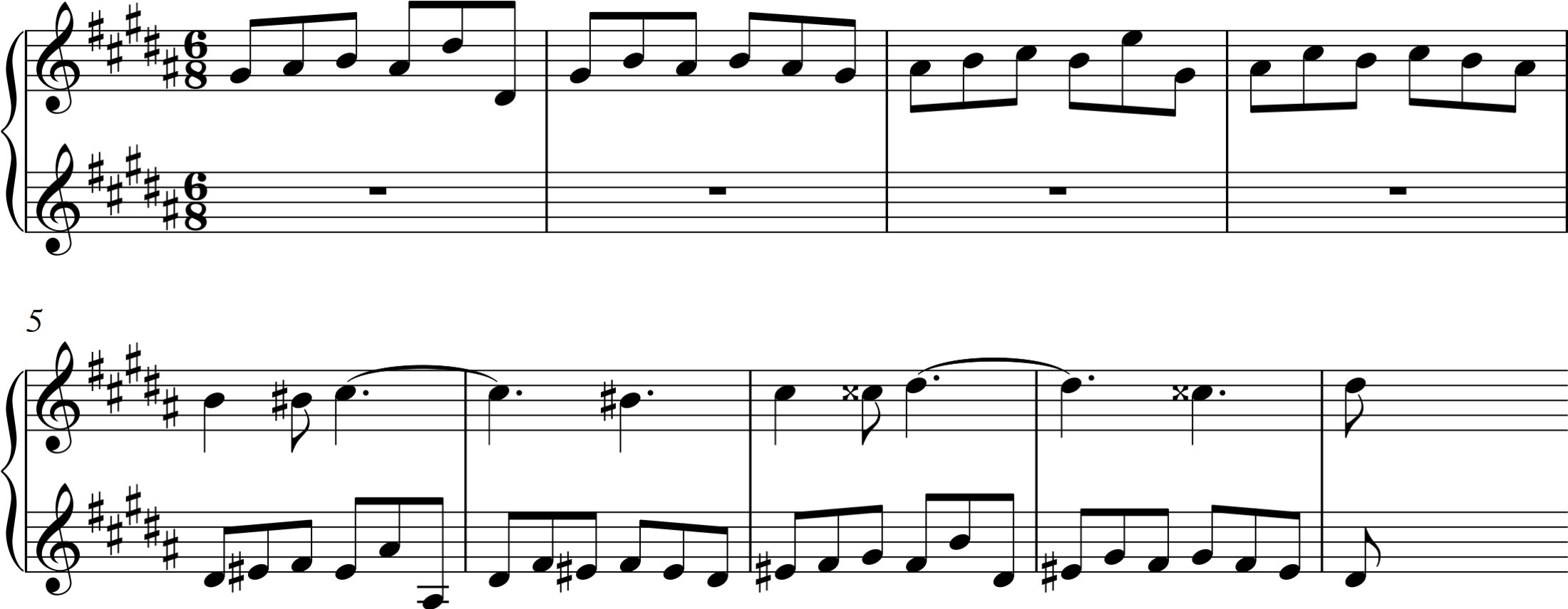
J. S. Bach, Prelude in G-sharp minor, The Well-Tempered Clavier, Book II, BWV 887. Printed score.
J. S. Bach, Prelude in G-sharp minor, The Well-Tempered Clavier, Book II, BWV 887. Printed score.
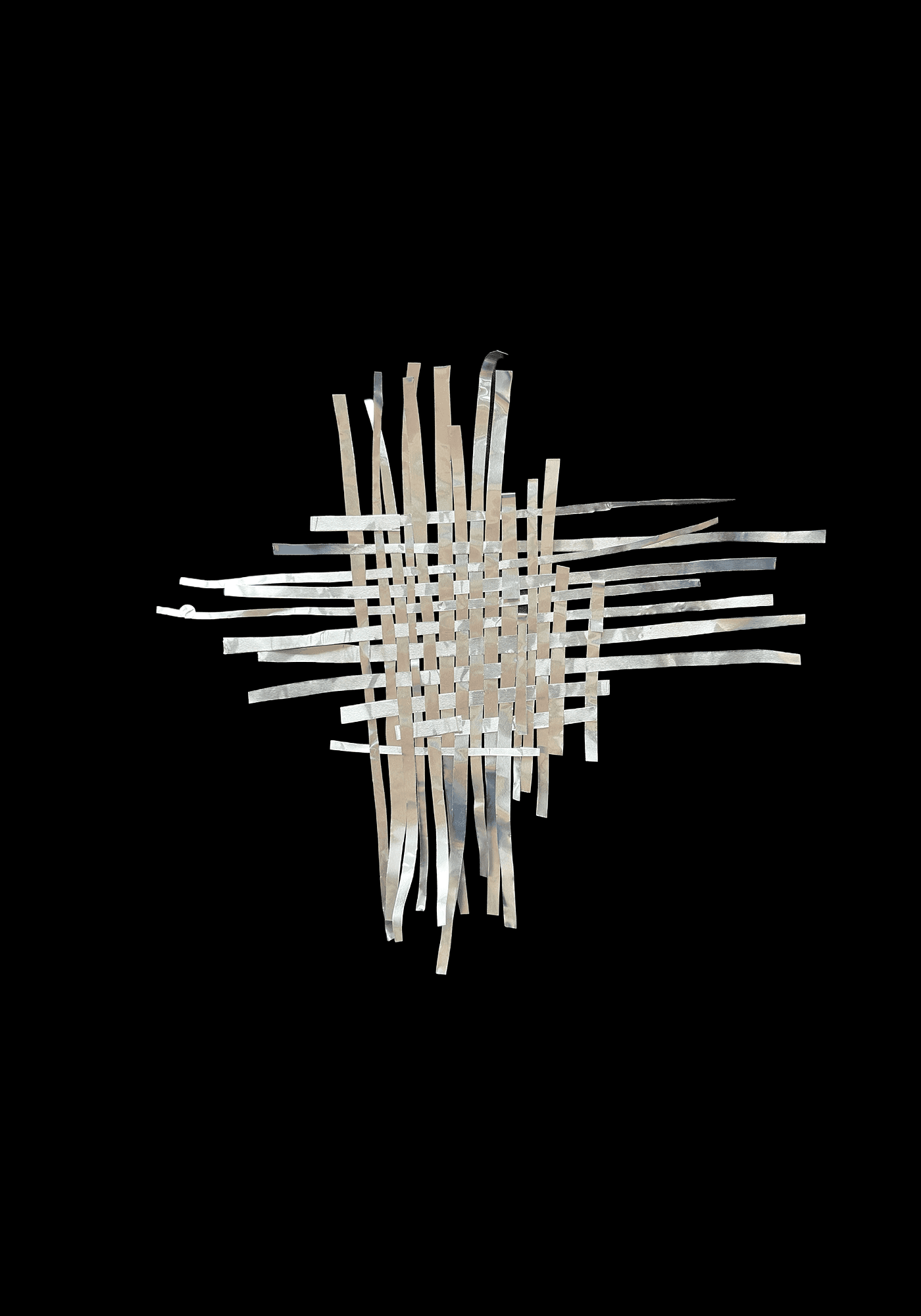
Foil, woven by hand. Liza Benesh, study for Counterpoint.
Foil, woven by hand. Liza Benesh, study for Counterpoint.
06
06
The poster
The Chair, in Foil
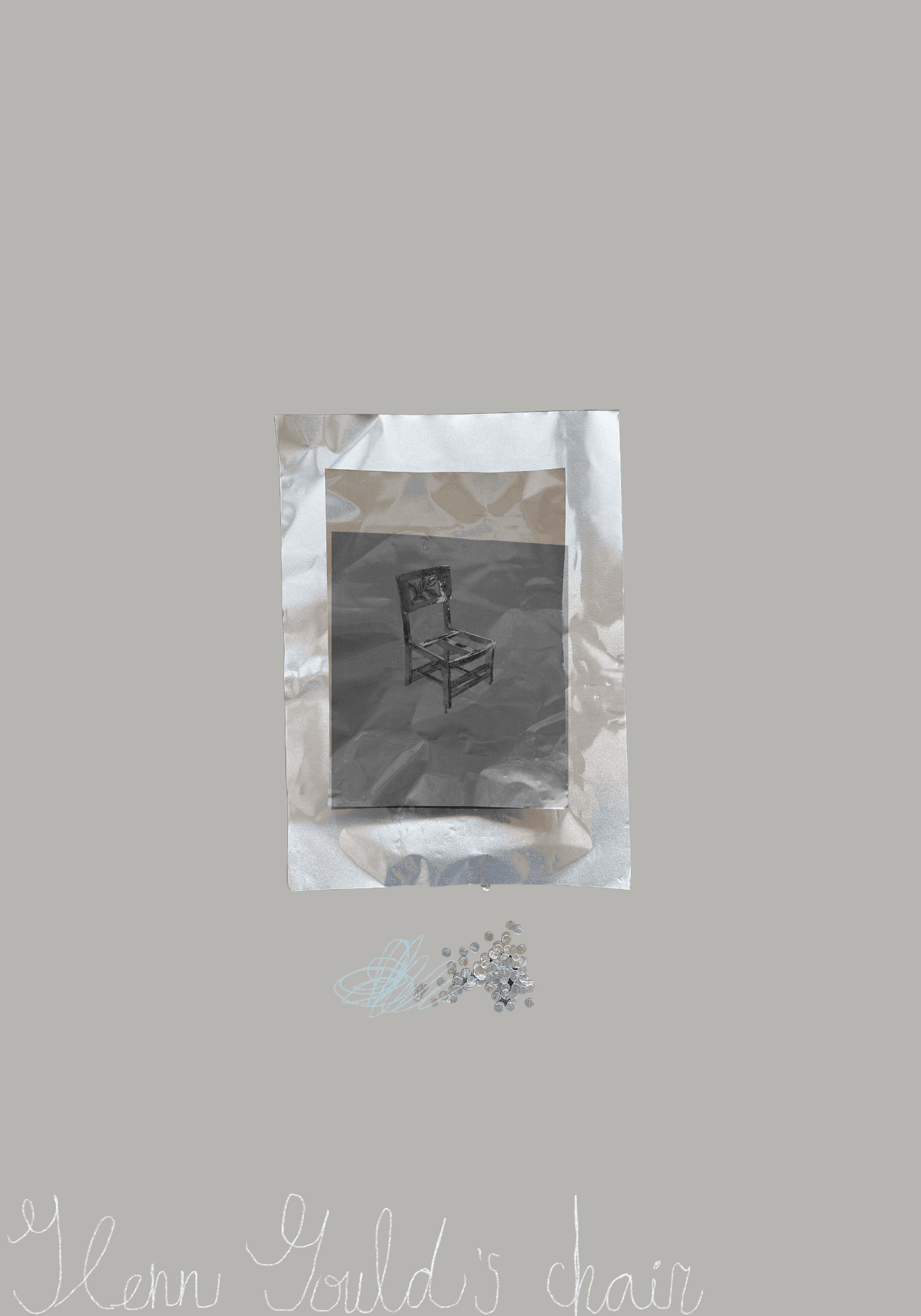
Liza Benesh, Glenn Gould’s Chair, 2026. Poster: aluminium foil, photography, digital composition.
Liza Benesh, Glenn Gould’s Chair, 2026. Poster: aluminium foil, photography, digital composition.
The chair is barely there: a relief pressed into crumpled foil, the kind that comes from a takeaway tray. You see it only when the light catches it.
The other two posters in the series, Counterpoint and Air, approach Bach himself — the building and the air between the voices. This one approaches his interpreter, through the most ordinary thing he owned.
The other two posters in the series, Counterpoint and Air, approach Bach himself — the building and the air between the voices. This one approaches his interpreter, through the most ordinary thing he owned.
The material: a takeaway tray.
The material: a takeaway tray.
Coda
Fourteen inches of wood, a seat worn through, and nearly thirty years of Bach.
A small object can hold a whole way of working: what to keep, what to refuse, how close to sit to the thing you love.
Sources
Library and Archives Canada, Glenn Gould virtual exhibition (collectionscanada.ca/glenngould).
Library and Archives Canada, Glenn Gould virtual exhibition (collectionscanada.ca/glenngould).
Glenn Gould, The Canadian Encyclopedia.
Glenn Gould, The Canadian Encyclopedia.
University of Ottawa, “Glenn Gould’s Piano Chair”, Linking Cultures collection (object record).
University of Ottawa, “Glenn Gould’s Piano Chair”, Linking Cultures collection (object record).
The Glenn Gould Foundation, “On Gould’s Signature Chair” (2021).
The Glenn Gould Foundation, “On Gould’s Signature Chair” (2021).
National Arts Centre, news release on the transfer of Gould’s chair and piano.
National Arts Centre, news release on the transfer of Gould’s chair and piano.
Kevin Bazzana, Wondrous Strange: The Life and Art of Glenn Gould (2003).
Kevin Bazzana, Wondrous Strange: The Life and Art of Glenn Gould (2003).
Glenn Gould, “The Prospects of Recording”, High Fidelity, April 1966.
Glenn Gould, “The Prospects of Recording”, High Fidelity, April 1966.
Columbia / Sony catalogue records: Goldberg Variations, ML 5060 (1956) and MK 37779 (1982).
Columbia / Sony catalogue records: Goldberg Variations, ML 5060 (1956) and MK 37779 (1982).
PBS, American Masters: Genius Within: The Inner Life of Glenn Gould — timeline.
PBS, American Masters: Genius Within: The Inner Life of Glenn Gould — timeline.
Glenn Gould · J. S. Bach · Foil
Text and posters: Liza Benesh
© Liza Benesh
Editorial · Glenn Gould · J. S. Bach · Foil
The Chair,
the Pianist
and Bach
20
15
14 in
10
5
0
Glenn Gould at a stage door, with his chair. Archival photograph.
A pianist who carried a battered folding chair across the world. Fourteen inches high, too low for any normal piano, the seat worn through to the frame. A small object — and a whole way of playing Bach folded into it.
This essay starts from one of my foil posters, Glenn Gould’s Chair, and follows the chair back to the man who sat on it.
How to read the claims
FACT Documented: archives, recordings, dates.
ANECDOTE Widely told, less firmly documented.
READING Interpretation — critics’, or this essay’s own.
01
The object
Fourteen Inches
It began as an ordinary folding chair from a card-table set. His father cut it down.
Fact
The chair was a high-backed wooden folding chair, one of a card-playing set made in the 1930s by Hourd & Company of London, Ontario. In 1953 Gould’s father, Bert Gould, sawed about four inches off each leg and fitted brass brackets so that every leg could be adjusted on its own.
The result put Gould’s seat about 14 inches (36 cm) above the floor — against roughly 20 inches for an ordinary piano bench. He played on it for the rest of his career, in the studio and on tour, and kept using it long after the seat had worn through to the frame.
The chair, seat worn away. Photograph.
On stage, beside the piano, seat in tatters. Photograph.
After his death in 1982 the chair went to Library and Archives Canada, which later transferred it to the National Arts Centre in Ottawa, where it is displayed in a glass case.
Diagram A — Six inches lower
Seat height of a standard piano bench and of Gould’s chair, drawn to the same scale. Figures from the Canadian Encyclopedia and the University of Ottawa object record. FACT
Standard piano bench
c. 20 in / 51 cm
Gould’s chair
c. 14 in / 36 cm
— 6 in lower —
Legs cut by c. 4 in / 10 cm (1953)
02
The body
Pulling Down
In the studio, on the chair, head near the keys. Archival photograph.
Fact
Sitting low was not a whim. It came from his teacher, Alberto Guerrero, whose idea was to pull down into the keys rather than strike them from above.
Guerrero also taught him a “finger-tapping” exercise: one hand taps the fingers of the other, relaxed hand, training each finger to move independently of the arm.
Pedagogues warned that sitting too low cramps the fingers. Gould sat low, slumped, leaned on a backrest — and built one of the cleanest finger techniques on record.
With an orchestra, the chair and a rug under his feet. Archival photograph.
On a television set, legs crossed. Archival photograph.
FACT The piano had to be set at a particular height and was raised on wooden blocks if necessary; sometimes a rug was needed under his feet.
The chair on an empty stage, gloves and scarf beside it. Archival photograph.
03
The image
Gloves, Water, Humming
The eccentric is the Gould everyone remembers. Most of the legend is true — but it was never the point.
Glenn Gould. Archival photograph.
Gloves and warm water
FACT He wore gloves in all weather and, before playing, soaked his hands and forearms in warm water — accounts give about twenty minutes.
Cold
FACT He feared catching cold, even in summer: coats, scarves, heated studios.
Humming
FACT He sang and hummed as he played, audibly enough that engineers never managed to remove it from his records. He reportedly saw it as a liability he could not play without.
Takeaway food
ANECDOTE He rarely cooked and lived on restaurant food — the story goes, often in aluminium trays. It is the thread that ties my foil to him.
04
The studio
Leaving the Stage
Fact
On 10 April 1964, aged 31, Gould gave a recital at the Wilshire Ebell Theatre in Los Angeles. He gave no sign that it would be his last. He never played a public concert again.
For the next eighteen years he worked in the studio, on the radio and in print. In “The Prospects of Recording”, an essay in High Fidelity in April 1966, he predicted that the public concert as we know it would not survive another century, its functions taken over by electronic media.
The young Gould at home, at the piano. Archival photograph.
Reading
The chair belongs to the same instinct. The audience, the hall, the coughing, the standard bench — all of it was negotiable. What was not negotiable was the distance between his hands and the keys.
Diagram B — Two Goldbergs, one chair
He opened and closed his recording career with the same Bach work, both times on the same chair. Dates from the Columbia and Sony catalogue records. FACT
1932
Born in Toronto, 25 September.
1953
Bert Gould cuts down the chair.
1955
Goldberg Variations, recorded in New York, 10–16 June.
1956
Released by Columbia: his debut album.
1964
Last public concert, Los Angeles, 10 April.
1981
Records the Goldberg Variations again.
1982
The new recording is released; he dies on 4 October.
05
The music
Structure and Air
Elias Gottlob Haussmann, Johann Sebastian Bach, 1748. Oil on canvas.
Fact
Bach’s keyboard music is built from independent voices: lines that move on their own and still hold together. Gould is remembered above all for making those lines audible — each voice articulated, none of them blurred into an accompaniment.
Reading
It is the paradox of his Bach: strict, almost architectural discipline, and inside it a freedom that many listeners found shocking — tempi taken very fast or very slow, ornaments rethought, the 1981 Goldbergs slower and more inward than the 1955 version.
Discipline as the condition of freedom — not its opposite.
Diagram C — Voices as strands
Three independent lines, each with its own contour, crossing without merging: the principle of counterpoint, and the principle of weaving foil. The lines are schematic. READING
━ Voice 1 ━ Voice 2 ━ Voice 3
J. S. Bach, Prelude in G-sharp minor, The Well-Tempered Clavier, Book II, BWV 887. Printed score.
Foil, woven by hand. Liza Benesh, study for Counterpoint.
06
The poster
The Chair, in Foil
Liza Benesh, Glenn Gould’s Chair, 2026. Poster: aluminium foil, photography, digital composition.
The chair is barely there: a relief pressed into crumpled foil, the kind that comes from a takeaway tray. You see it only when the light catches it.
The other two posters in the series, Counterpoint and Air, approach Bach himself — the building and the air between the voices. This one approaches his interpreter, through the most ordinary thing he owned.
The material: a takeaway tray.
Coda
Fourteen inches of wood, a seat worn through, and nearly thirty years of Bach.
A small object can hold a whole way of working: what to keep, what to refuse, how close to sit to the thing you love.
Sources
Library and Archives Canada, Glenn Gould virtual exhibition (collectionscanada.ca/glenngould).
Glenn Gould, The Canadian Encyclopedia.
University of Ottawa, “Glenn Gould’s Piano Chair”, Linking Cultures collection (object record).
The Glenn Gould Foundation, “On Gould’s Signature Chair” (2021).
National Arts Centre, news release on the transfer of Gould’s chair and piano.
Kevin Bazzana, Wondrous Strange: The Life and Art of Glenn Gould (2003).
Glenn Gould, “The Prospects of Recording”, High Fidelity, April 1966.
Columbia / Sony catalogue records: Goldberg Variations, ML 5060 (1956) and MK 37779 (1982).
PBS, American Masters: Genius Within: The Inner Life of Glenn Gould — timeline.
Subject
Glenn Gould · J. S. Bach · Foil
Credits
Text and posters: Liza Benesh
Related project / Mixed media
Bach in Foil →

← Previous editorial
Serpents, Eyes, Arrows

Next editorial →
Three Dates, Three Stories
© Liza Benesh